Menu
The first decentralized L2 on Ethereum reaches 75k block height with 30M $AZTEC distributed through block rewards.
In November 2025, the Aztec Ignition Chain went live as the first decentralized L2 on Ethereum. Since launch, more than 185 operators across 5 continents have joined the network, with 3,400+ sequencers now running. The Ignition Chain is the backbone of the Aztec Network; true end-to-end programmable privacy is only possible when the underlying network is decentralized and permissionless.
Until now, only participants from the $AZTEC token sale have been able to stake and earn block rewards ahead of Aztec's upcoming Token Generation Event (TGE), but that's about to change. Keep reading for an update on the state of the network and learn how you can spin up your own sequencer or start delegating your tokens to stake once TGE goes live.
The Ignition Chain launched to prove the stability of the consensus layer before the execution environment ships, which will enable privacy-preserving smart contracts. The network has remained healthy, crossing a block height of 75k blocks with zero downtime. That includes navigating Ethereum's major Fusaka upgrade in December 2025 and a governance upgrade to increase the queue speed for joining the sequencer set.
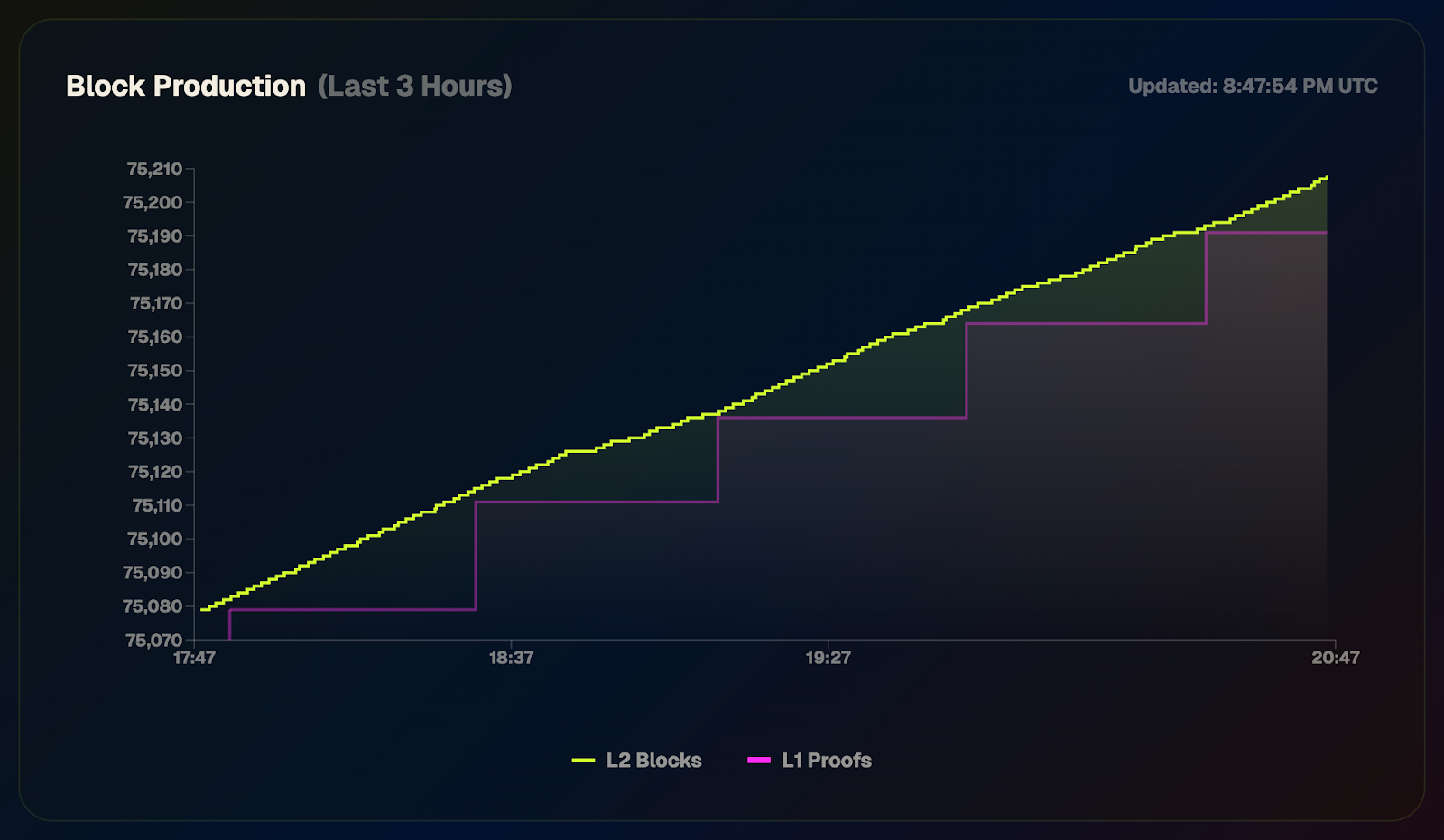
Over 30M $AZTEC tokens have been distributed to sequencers and provers to date. Block rewards go out every epoch (every 32 blocks), with 70% going to sequencers and 30% going to provers for generating block proofs.
If you don't want to run your own node, you can delegate your stake and share in block rewards through the staking dashboard. Note that fractional staking is not currently supported, so you'll need 200k $AZTEC tokens to stake.
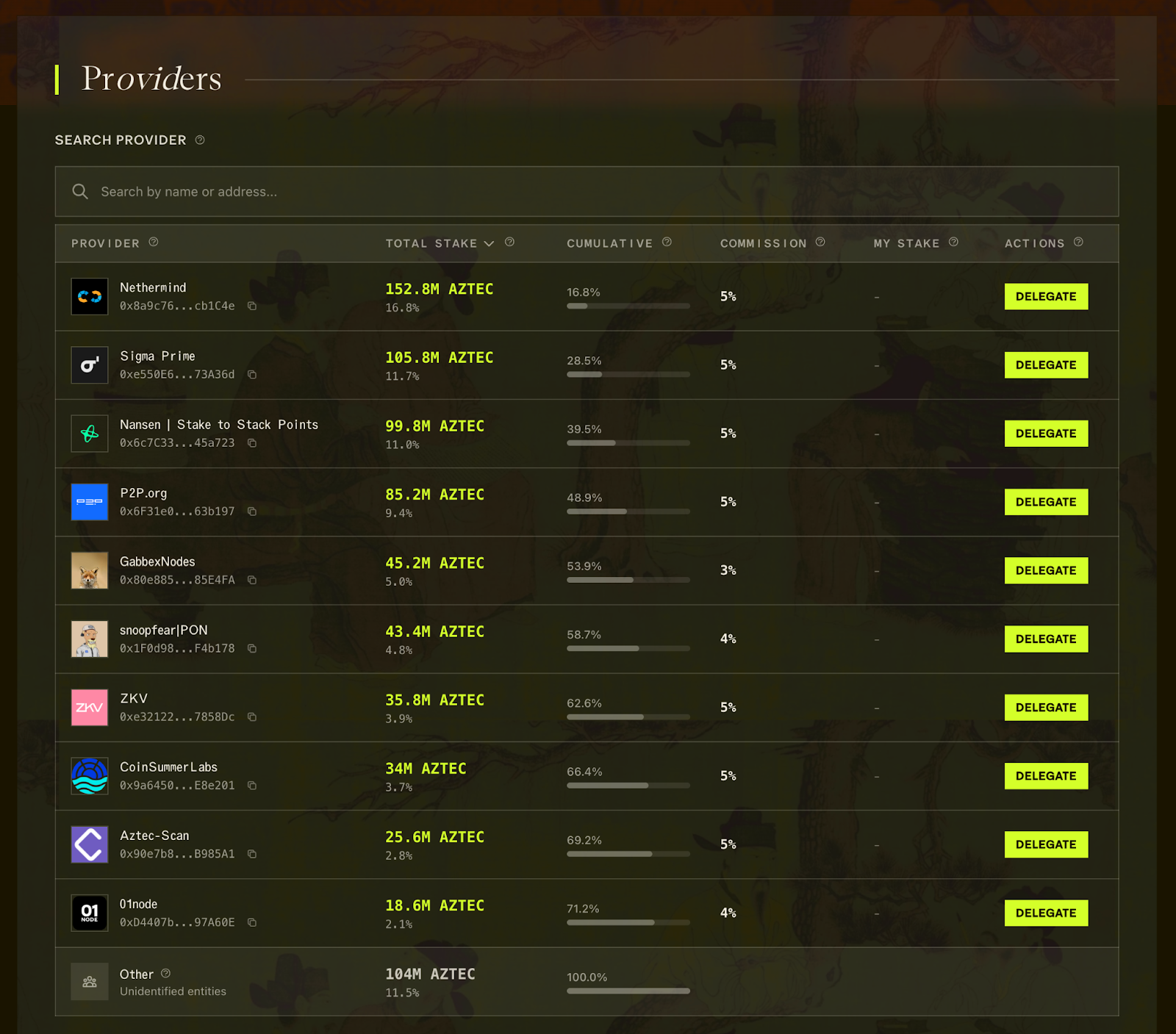
The Ignition Chain launched as a decentralized network from day one. The Aztec Labs and Aztec Foundation teams are not running any sequencers on the network or participating in governance. This is your network.
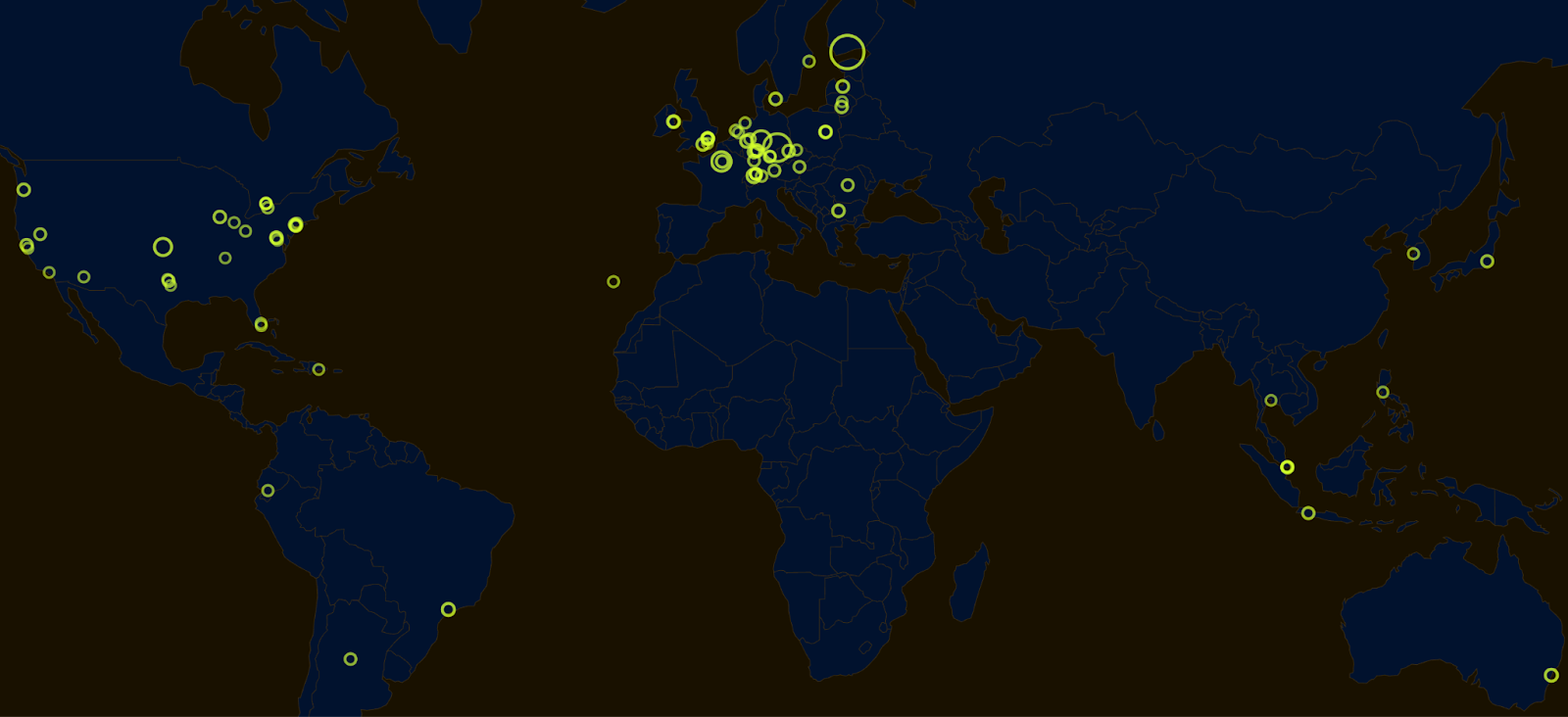
Anyone who purchased 200k+ tokens in the token sale can stake or delegate their tokens on the staking dashboard. Over 180 operators are now running sequencers, with more joining daily as they enter the sequencer set from the queue. And it's not just sequencers: 50+ provers have joined the permissionless, decentralized prover network to generate block proofs.
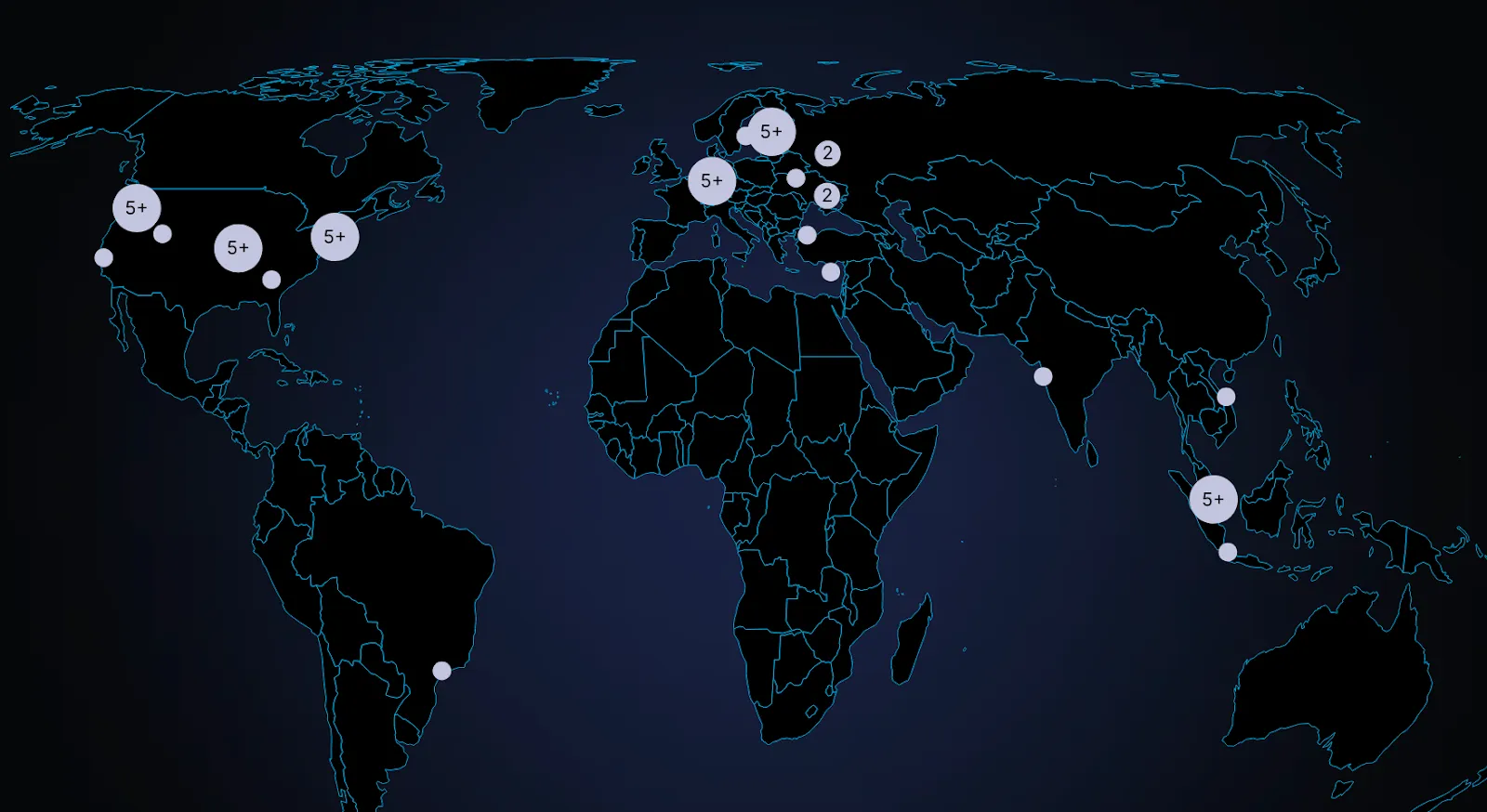
These operators span the globe, from solo stakers to data centers, from Australia to Portugal.
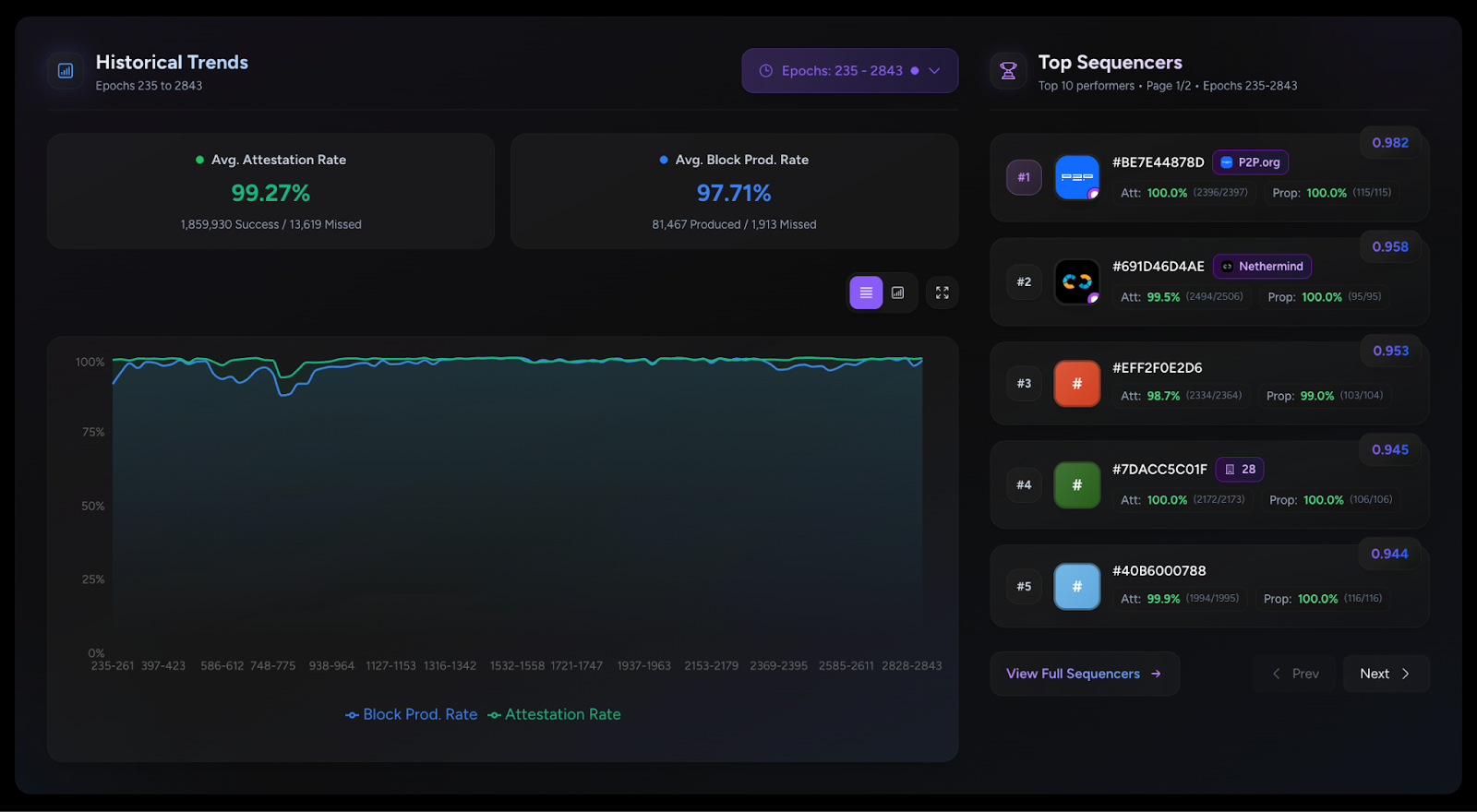
Participating sequencers have maintained a 99%+ attestation rate since network launch, demonstrating strong commitment and network health. Top performers include P2P.org, Nethermind, and ZKV. You can see all block activity and staker performance on the Dashtec dashboard.
On January 26th, 2026, the community passed a governance proposal for TGE. This makes tokens tradable and unlocks the AZTEC/ETH Uniswap pool as early as February 11, 2026. Once that happens, anyone with 200k $AZTEC tokens can run a sequencer or delegate their stake to participate in block rewards.
Here's what you need to run a validator node:
These are accessible specs for most solo stakers. If you've run an Ethereum validator before, you're already well-equipped.
To get started, head to the Aztec docs for step-by-step instructions on setting up your node. You can also join the Discord to connect with other operators, ask questions, and get support from the community. Whether you run your own hardware or delegate to an experienced operator, you're helping build the infrastructure for a privacy-preserving future.
Solo stakers are the beating heart of the Aztec Network. Welcome aboard.
The $AZTEC token sale was the first of its kind, conducted entirely onchain with ~50% of the capital committed coming from the community. The sale was conducted completely onchain to ensure that you have control over your tokens from day one. As we approach the TGE vote, all token sale participants will be able to vote to unlock their tokens and make them tradable.
Immediately following the $AZTEC token sale, tokens could be withdrawn from the sale website into your personal Token Vault smart contracts on the Ethereum mainnet. Right now, token holders are not able to transfer or trade these tokens.
The TGE is a governance vote that decides when to unlock these tokens. If the vote passes, three things happen:
This decision is entirely in the hands of $AZTEC token holders. The Aztec Labs and Aztec Foundation teams, and investors cannot participate in staking or governance for 12 months, which includes the TGE governance proposal. Team and investor tokens will also remain locked for 1 year and then slowly unlock over the next 2 years.
The proposal for TGE is now live, and sequencers are already signaling to bring the proposal to a vote. Once enough sequencers have signaled, anyone who participated in the token sale will be able to connect their Token Vault contract to the governance dashboard to vote. Note, this will require you to stake/unstake and follow the regular 15-day process to withdraw tokens.
If the vote passes, TGE can go live as early as February 12, 2026, at 7am UTC. TGE can be executed by the first person to call the execute function to execute the proposal after the time above.
If you participated in the token sale, you don't have to do anything if you prefer not to vote. If the vote passes, your tokens will become available to trade at TGE. If you want to vote, the process happens in two phases:
Sequencers kick things off by signaling their support. Once 600 out of 1,000 sequencers signal, the proposal moves to a community vote.
After sequencers create the proposal, all Token Vault holders can vote using the voting governance dashboard. Please note that anyone who wants to vote must stake their tokens, locking their tokens for at least 15 days to ensure the proposal can be executed before the voter exits. Once signaling is complete, the timeline is as follows:
Vote Requirements:
Do I need to participate in the vote? No. If you don't vote, your tokens will become available for trading when TGE goes live.
Can I vote if I have less than 200,000 tokens? Yes! Anyone who participated in the token sale can participate in the TGE vote. You'll need to connect your wallet to the governance dashboard to vote.
Is there a withdrawal period for my tokens after I vote? Yes. If you participate in the vote, you will need to withdraw your tokens after voting. Voters can initiate a withdrawal of their tokens immediately after voting, but require a standard 15-day withdrawal period to ensure the vote is executed before voters can exit.
If I have over 200,000 tokens is additional action required to make my tokens tradable after TGE? Yes. If you purchased over 200,000 $AZTEC tokens, you will need to stake your tokens before they become tradable.
What if the vote fails? A new proposal can be submitted. Your tokens remain locked until a successful vote is completed, or the fallback date of November 13, 2026, whichever happens first.
I'm a Genesis sequencer. Does this apply to me? Genesis sequencer tokens cannot be unlocked early. You must wait until November 13, 2026, to withdraw. However, you can still influence the vote by signaling, earn block rewards, and benefit from trading being enabled.
This overview covers the essentials, but the full technical proposal includes contract addresses, code details, and step-by-step instructions for sequencers and advanced users.
Read the complete proposal on the Aztec Forum and join us for the Privacy Rabbit Hole on Discord happening this Thursday, January 22, 2026, at 15:00 UTC.
Follow Aztec on X to stay up to date on the latest developments.
The $AZTEC token sale was conducted entirely onchain to maximize transparency and fair distribution. Next steps for holders are as follows:
The $AZTEC token sale has come to a close– the sale was conducted entirely onchain, and the power is now in your hands. Over 16.7k people participated, with 19,476 ETH raised. A huge thank you to our community and everyone who participated– you all really showed up for privacy. 50% of the capital committed has come from the community of users, testnet operators and creators!
Now that you have your tokens, what’s next? This guide walks you through the next steps leading up to TGE, showing you how to withdraw, stake, and vote with your tokens.
The $AZTEC sale was conducted onchain to ensure that you have control over your own tokens from day 1 (even before tokens become transferable at TGE).
The team has no control over your tokens. You will be self-custodying them in a smart contract known as the Token Vault on the Ethereum mainnet ahead of TGE.
Your Token Vault contract will:
To create and withdraw your tokens to your Token Vault, simply go to the sale website and click on ‘Create Token Vault.’ Any unused ETH from your bids will be returned to your wallet in the process of creating your Token Vault.
If you have 200,000+ tokens, you are eligible to start staking and earning block rewards today.
You can stake by connecting your Token Vault to the staking dashboard, just select a provider to delegate your stake. Alternatively, you can run your own sequencer node.
If your Token Vault holds 200,000+ tokens, you must stake in order to withdraw your tokens after TGE. If your Token Vault holds less than 200,000 tokens, you can withdraw without any additional steps at TGE
Fractional staking for anyone with less than 200,000 tokens is not currently supported, but multiple external projects are already working to offer this in the future.
TGE is triggered by an onchain governance vote, which can happen as early as February 11th, 2026.
At TGE, 100% of tokens from the token sale will be transferable. Only token sale participants and genesis sequencers can participate in the TGE vote, and only tokens purchased in the sale will become transferrable.
Community members discuss potential votes on the governance forum. If the community agrees, sequencers signal to start a vote with their block proposals. Once enough sequencers agree, the vote goes onchain for eligible token holders.
Voting lasts 7 days, requires participation of at least 100,000,000 $AZTEC tokens, and passes if 2/3 vote yes.
Following a successful yes vote, anyone can execute the proposal after a 7-day execution delay, triggering TGE.
At TGE, the following tokens will be 100% unlocked and available for trading:
Join us Thursday, December 11th at 3 pm UTC for the next Discord Town Hall–AMA style on next steps for token holders. Follow Aztec on X to stay up to date on the latest developments.
We invented the math. We wrote the language. Proved the concept and now, we’re opening registration and bidding for the $AZTEC token today, starting at 3 pm CET.
The community-first distribution offers a starting floor price based on a $350 million fully diluted valuation (FDV), representing an approximate 75% discount to the implied network valuation (based on the latest valuation from Aztec Labs’ equity financings). The auction also features per-user participation caps to give community members genuine, bid-clearing opportunities to participate daily through the entirety of the auction.
The token auction portal is live at: sale.aztec.network
We’ve taken the community access that made the 2017 ICO era great and made it even better.
For the past several months, we've worked closely with Uniswap Labs as core contributors on the CCA protocol, a set of smart contracts that challenge traditional token distribution mechanisms to prioritize fair access, permissionless, on-chain access to community members and the general public pre-launch. This means that on day 1 of the unlock, 100% of the community's $AZTEC tokens will be unlocked.
This model is values-aligned with our Core team and addresses the current challenges in token distribution, where retail participants often face unfair disadvantages against whales and institutions that hold large amounts of money.
Early contributors and long-standing community members, including genesis sequencers, OG Aztec Connect users, network operators, and community members, can start bidding today, ahead of the public auction, giving those who are whitelisted a head start and early advantage for competitive pricing. Community members can participate by visiting the token sale site to verify eligibility and mint a soul-bound NFT that confirms participation rights.
To read more about Aztec’s fair-access token sale, visit the economic and technical whitepapers and the token regulatory report.
Discount Price Disclaimer: Any reference to a prior valuation or percentage discount is provided solely to inform potential purchasers of how the initial floor price for the token sale was calculated. Equity financing valuations were determined under specific circumstances that are not comparable to this offering. They do not represent, and should not be relied upon as, the current or future market value of the tokens, nor as an indication of potential returns. The price of tokens may fluctuate substantially, the token may lose its value in part or in full, and purchasers should make independent assessments without reliance on past valuations. No representation or warranty is made that any purchaser will achieve profits or recover the purchase price.
Information for Persons in the UK: This communication is directed only at persons outside the UK. Persons in the UK are not permitted to participate in the token sale and must not act upon this communication.
MiCA Disclaimer: Any crypto-asset marketing communications made from this account have not been reviewed or approved by any competent authority in any Member State of the European Union. Aztec Foundation as the offeror of the crypto-asset is solely responsible for the content of such crypto-asset marketing communications. The Aztec MiCA white paper has been published and is available here. The Aztec Foundation can be contacted at hello@aztec.foundation or +41 41 710 16 70. For more information about the Aztec Foundation, visit https://aztec.foundation.
Every time you swap tokens on Uniswap, deposit into a yield vault, or vote in a DAO, you're broadcasting your moves to the world. Anyone can see what you own, where you trade, how much you invest, and when you move your money.
Tracking and analysis tools like Chainalysis and TRM are already extremely advanced, and will only grow stronger with advances in AI in the coming years. The implications of this are that the ‘pseudo-anonymous’ wallets on Ethereum are quickly becoming linked to real-world identities. This is concerning for protecting your personal privacy, but it’s also a major blocker in bringing institutions on-chain with full compliance for their users.
Until now, your only option was to abandon your favorite apps and move to specialized privacy-focused apps or chains with varying degrees of privacy. You'd lose access to the DeFi ecosystem as you know it now, the liquidity you depend on, and the community you're part of.
What if you could keep using Uniswap, Aave, Yearn, and every other app you love, but with your identity staying private? No switching chains. Just an incognito mode for your existing on-chain life?
If you’ve been following Aztec for a while, you would be right to think about Aztec Connect here, which was hugely popular with $17M TVL and over 100,000 active wallets, but was sunset in 2024 to focus on bringing a general-purpose privacy network to life.
Read on to learn how you’ll be able to import privacy to any L2, using one of the many privacy-focused bridges that are already built.
Aztec is a fully decentralized, privacy-preserving L2 on Ethereum. You can think of Aztec as a private world computer with full end-to-end programmable privacy. A private world computer extends Ethereum to add optional privacy at every level, from identity and transactions to the smart contracts themselves.
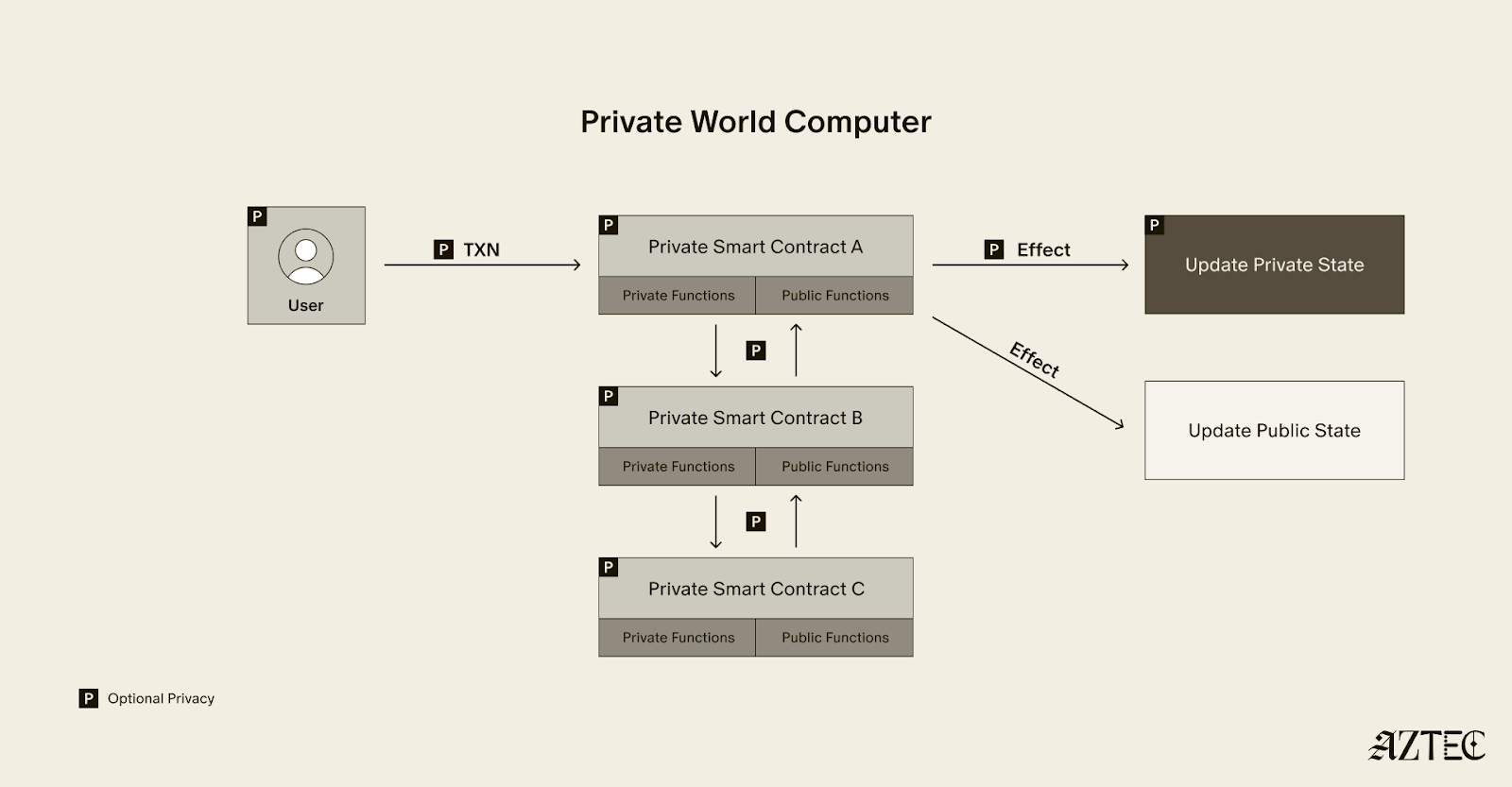
On Aztec, every wallet is a smart contract that gives users complete control over which aspects they want to make public or keep private.
Aztec is currently in Testnet, but will have multiple privacy-preserving bridges live for its mainnet launch, unlocking a myriad of privacy preserving features.
Now, several bridges, including Wormhole, TRAIN, and Substance, are connecting Aztec to other chains, adding a privacy layer to the L2s you already use. Think of it as a secure tunnel between you and any DeFi app on Ethereum, Arbitrum, Base, Optimism, or other major chains.
Here's what changes: You can now use any DeFi protocol without revealing your identity. Furthermore, you can also unlock brand new features that take advantage of Aztec’s private smart contracts, like private DAO voting or private compliance checks.
Here's what you can do:
The apps stay where they are. Your liquidity stays where it is. Your community stays where it is. You just get a privacy upgrade.
Let's follow Alice through a real example.
Alice wants to invest $1,000 USDC into a yield vault on Arbitrum without revealing her identity.
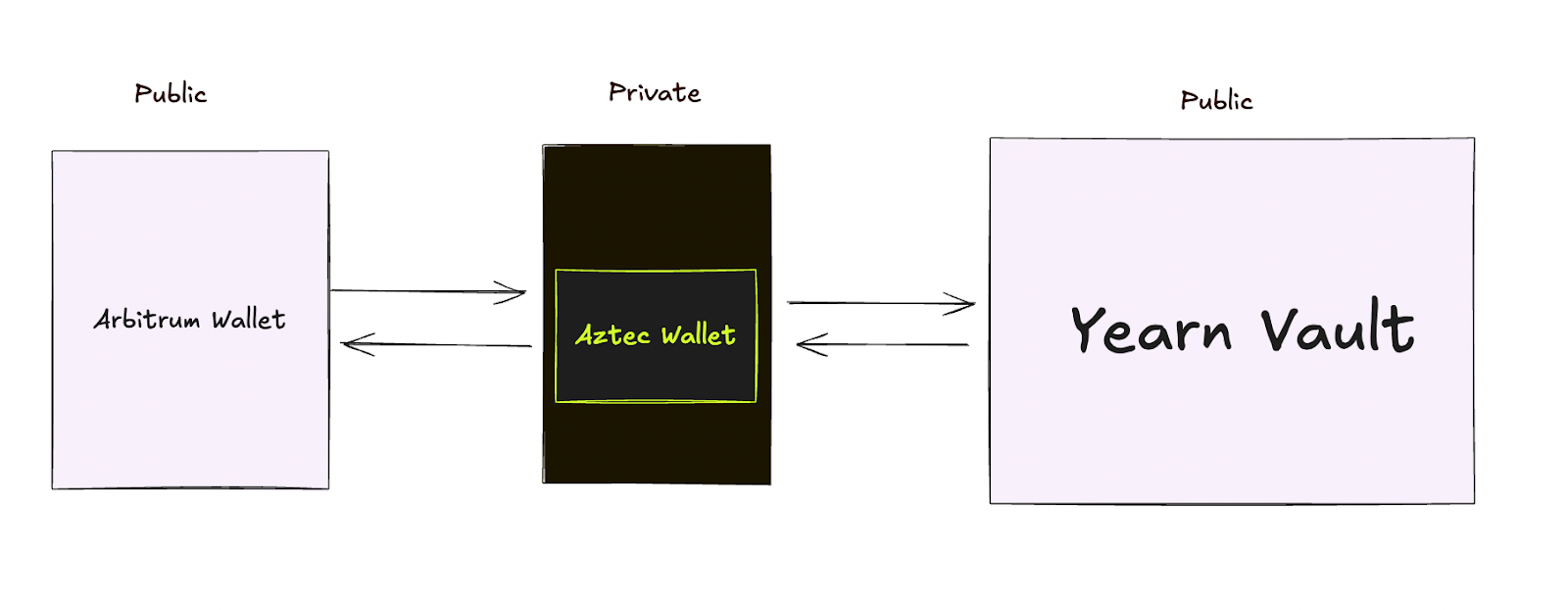
Alice moves her funds into Aztec's privacy layer. This could be done in one click directly in the app that she’s already using if the app has integrated one of the bridges. Think of this like dropping a sealed envelope into a secure mailbox. The funds enter a private space where transactions can't be tracked back to her wallet.
Aztec routes Alice's funds to the Yearn vault on Arbitrum. The vault sees a deposit and issues yield-earning tokens. But there's no way to trace those tokens back to Alice's original wallet. Others can see someone made a deposit, but they have no idea who.
The yield tokens arrive in Alice's private Aztec wallet. She can hold them, trade them privately, or eventually withdraw them, without anyone connecting the dots.
Alice is earning yield on Arbitrum using the exact same vault as everyone else. But while other users broadcast their entire investment strategy, Alice's moves remain private.
The difference looks like this:
Without privacy: "Wallet 0x742d...89ab deposited $5,000 into Yearn vault at 2:47 PM"
With Aztec privacy: "Someone deposited funds into Yearn vault" (but who? from where? how much? unknowable).
In the future, we expect apps to directly integrate Aztec, making this experience seamless for you as a user.
While Aztec is still in Testnet, multiple teams are already building bridges right now in preparation for the mainnet launch.
Projects like Substance Labs, Train, and Wormhole are creating connections between Aztec and major chains like Optimism, Unichain, Solana, and Aptos. This means you'll soon have private access to DeFi across nearly every major ecosystem.
Aztec has also launched a dedicated cross-chain catalyst program to support developers with grants to build additional bridges and apps.
L2s have sometimes received criticism for fragmenting liquidity across chains. Aztec is taking a different approach. Instead, Aztec is bringing privacy to the liquidity that already exists. Your funds stay on Arbitrum, Optimism, Base, wherever the deepest pools and best apps already live. Aztec doesn't compete for liquidity, it adds privacy to existing liquidity.
You can access Uniswap's billions in trading volume. You can tap into Aave's massive lending pools. You can deposit into Yearn's established vaults, all without moving liquidity away from where it's most useful.
We’re rolling out a new approach to how we think about L2s on Ethereum. Rather than forcing users to choose between privacy and access to the best DeFi applications, we’re making privacy a feature you can add to any protocol you're already using. As more bridges go live and applications integrate Aztec directly, using DeFi privately will become as simple as clicking a button—no technical knowledge required, no compromise on the apps and liquidity you depend on.
While Aztec is currently in testnet, the infrastructure is rapidly taking shape. With multiple bridge providers building connections to major chains and a dedicated catalyst program supporting developers, the path to mainnet is clear. Soon, you'll be able to protect your privacy while still participating fully in the Ethereum ecosystem.
If you’re a developer and want a full technical breakdown, check out this post. To stay up to date with the latest updates for network operators, join the Aztec Discord and follow Aztec on X.
Privacy has emerged as a major driver for the crypto industry in 2025. We’ve seen the explosion of Zcash, the Ethereum Foundation’s refocusing of PSE, and the launch of Aztec’s testnet with over 24,000 validators powering the network. Many apps have also emerged to bring private transactions to Ethereum and Solana in various ways, and exciting technologies like ZKPassport that privately bring identity on-chain using Noir have become some of the most talked about developments for ushering in the next big movements to the space.
Underpinning all of these developments is the emerging consensus that without privacy, blockchains will struggle to gain real-world adoption.
Without privacy, institutions can’t bring assets on-chain in a compliant way or conduct complex swaps and trades without revealing their strategies. Without privacy, DeFi remains dominated and controlled by advanced traders who can see all upcoming transactions and manipulate the market. Without privacy, regular people will not want to move their lives on-chain for the entire world to see every detail about their every move.
While there's been lots of talk about privacy, few can define it. In this piece we’ll outline the three pillars of privacy and gives you a framework for evaluating the privacy claims of any project.
True privacy rests on three essential pillars: transaction privacy, identity privacy, and computational privacy. It is only when we have all three pillars that we see the emergence of a private world computer.
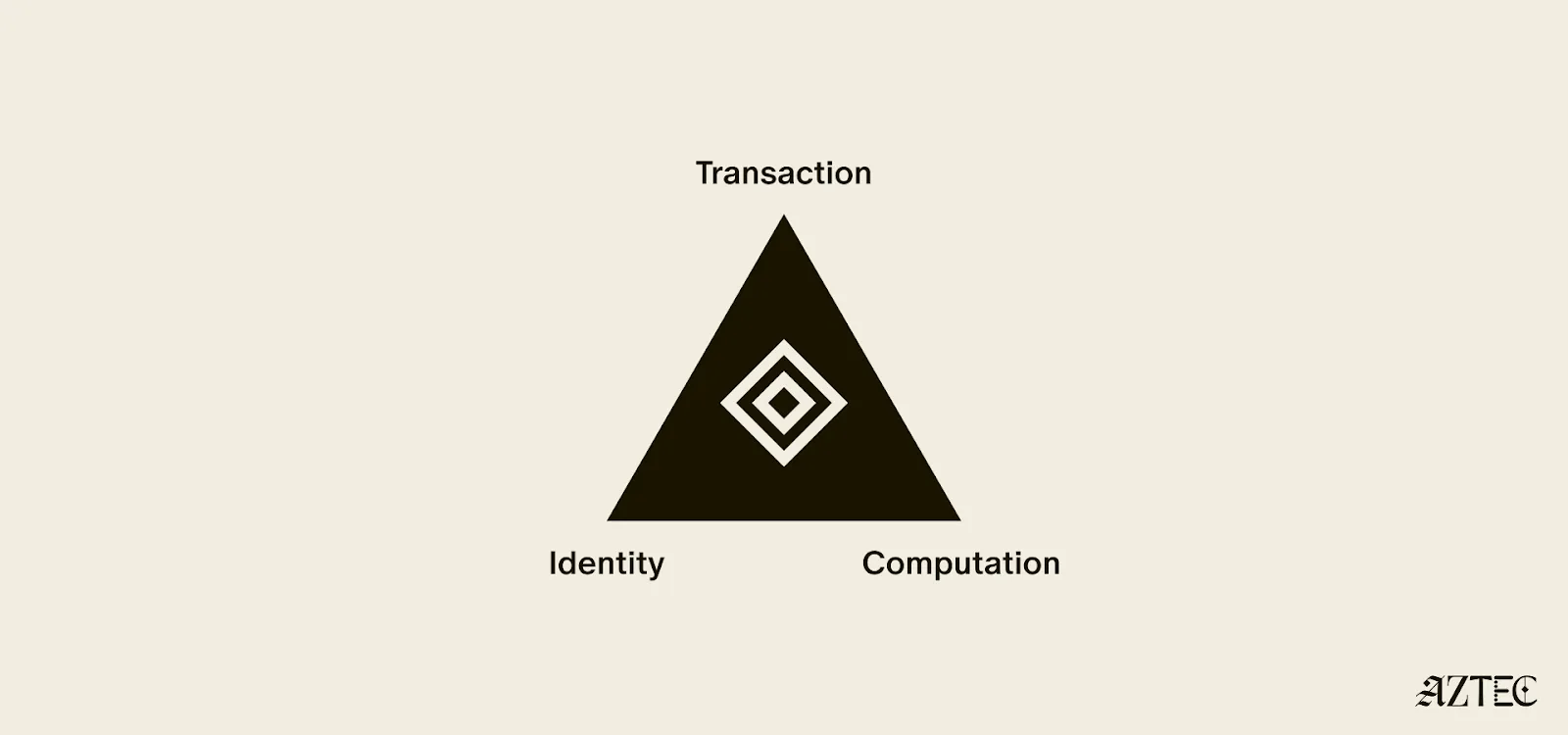
Transaction privacy means that both inputs and outputs are not viewable by anyone other than the intended participants. Inputs include any asset, value, message, or function calldata that is being sent. Outputs include any state changes or transaction effects, or any transaction metadata caused by the transaction. Transaction privacy is often primarily achieved using a UTXO model (like Zcash or Aztec’s private state tree). If a project has only the option for this pillar, it can be said to be confidential, but not private.
Identity privacy means that the identities of those involved are not viewable by anyone other than the intended participants. This includes addresses or accounts and any information about the identity of the participants, such as tx.origin, msg.sender, or linking one’s private account to public accounts. Identity privacy can be achieved in several ways, including client-side proof generation that keeps all user info on the users’ devices. If a project has only the option for this pillar, it can be said to be anonymous, but not private.
Computation privacy means that any activity that happens is not viewable by anyone other than the intended participants. This includes the contract code itself, function execution, contract address, and full callstack privacy. Additionally, any metadata generated by the transaction is able to be appropriately obfuscated (such as transaction effects, events are appropriately padded, inclusion block number are in appropriate sets). Callstack privacy includes which contracts you call, what functions in those contracts you’ve called, what the results of those functions were, any subsequent functions that will be called after, and what the inputs to the function were. A project must have the option for this pillar to do anything privately other than basic transactions.
Bitcoin ushered in a new paradigm of digital money. As a permissionless, peer-to-peer currency and store of value, it changed the way value could be sent around the world and who could participate. Ethereum expanded this vision to bring us the world computer, a decentralized, general-purpose blockchain with programmable smart contracts.
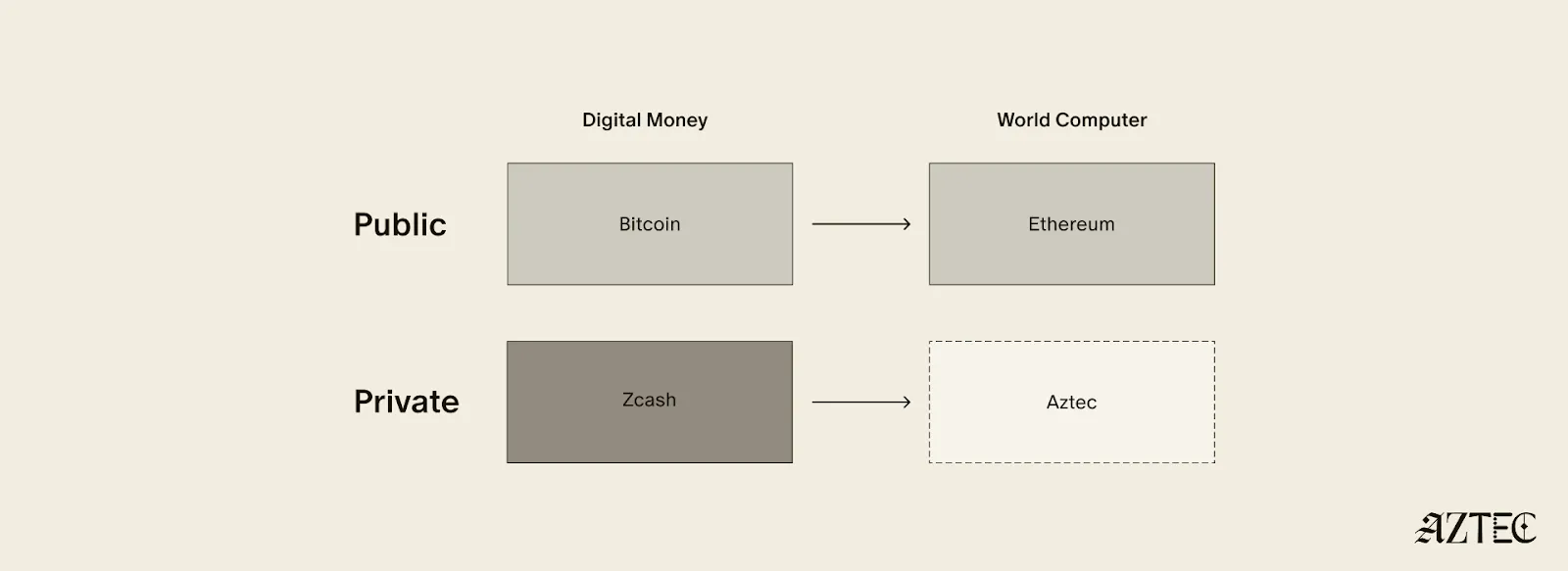
Given the limitations of running a transparent blockchain that exposes all user activity, accounts, and assets, it was clear that adding the option to preserve privacy would unlock many benefits (and more closely resemble real cash). But this was a very challenging problem. Zcash was one of the first to extend Bitcoin’s functionality with optional privacy, unlocking a new privacy-preserving UTXO model for transacting privately. As we’ll see below, many of the current privacy-focused projects are working on similar kinds of private digital money for Ethereum or other chains.
Now, Aztec is bringing us the final missing piece: a private world computer.
A private world computer is fully decentralized, programmable, and permissionless like Ethereum and has optional privacy at every level. In other words, Aztec is extending all the functionality of Ethereum with optional transaction, identity, and computational privacy. This is the only approach that enables fully compliant, decentralized applications to be built that preserve user privacy, a new design space that we see as ushering in the next Renaissance for the space.
Private digital money emerges when you have the first two privacy pillars covered - transactions and identity - but you don’t have the third - computation. Almost all projects today that claim some level of privacy are working on private digital money. This includes everything from privacy pools on Ethereum and L2s to newly emerging payment L1s like Tempo and Arc that are developing various degrees of transaction privacy
When it comes to digital money, privacy exists on a spectrum. If your identity is hidden but your transactions are visible, that's what we call anonymous. If your transactions are hidden but your identity is known, that's confidential. And when both your identity and transactions are protected, that's true privacy. Projects are working on many different approaches to implement this, from PSE to Payy using Noir, the zkDSL built to make it intuitive to build zk applications using familiar Rust-like syntax.
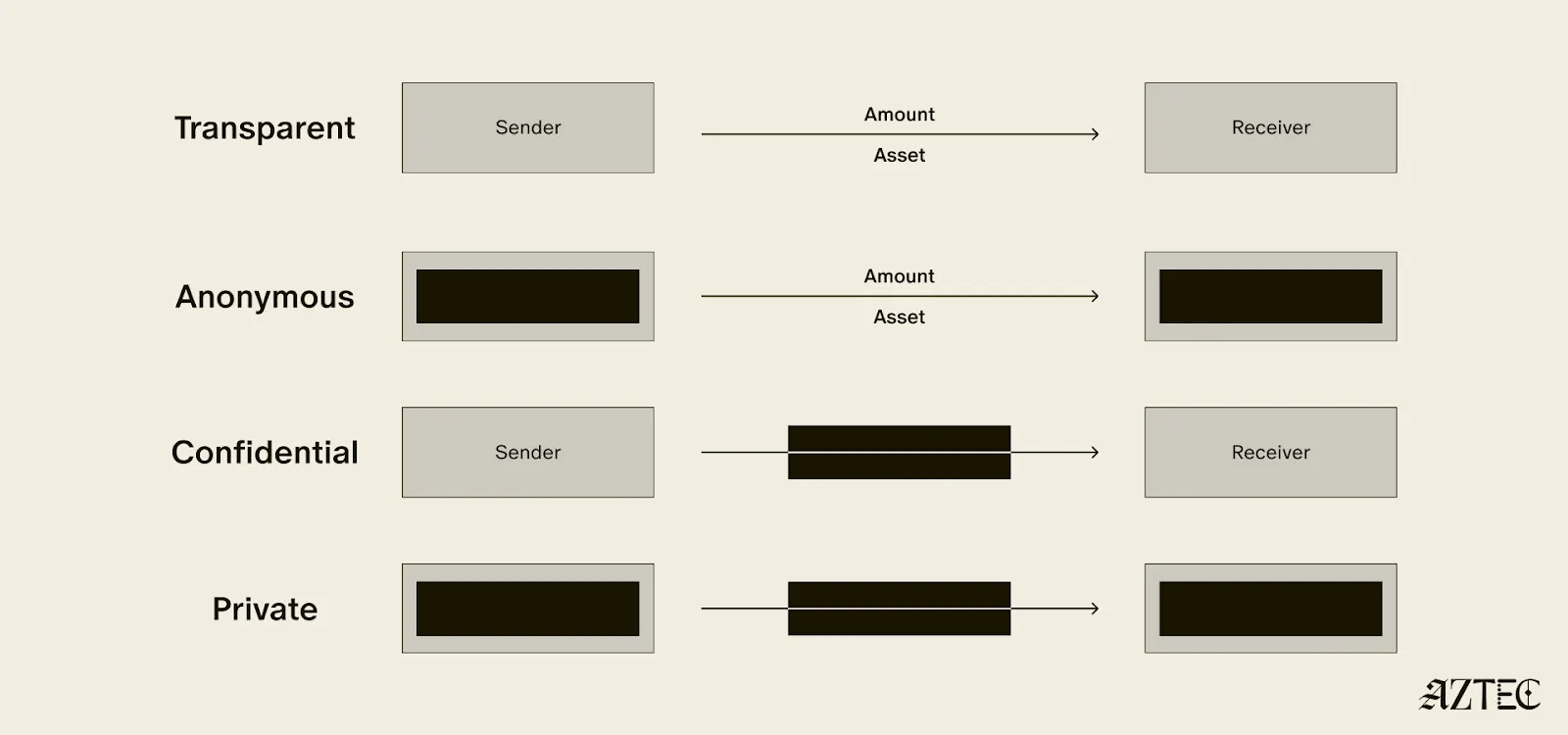
Private digital money is designed to make payments private, but any interaction with more complex smart contracts than a straightforward payment transaction is fully exposed.
What if we also want to build decentralized private apps using smart contracts (usually multiple that talk to each other)? For this, you need all three privacy pillars: transaction, identity, and compute.
If you have these three pillars covered and you have decentralization, you have built a private world computer. Without decentralization, you are vulnerable to censorship, privileged backdoors and inevitable centralized control that can compromise privacy guarantees.
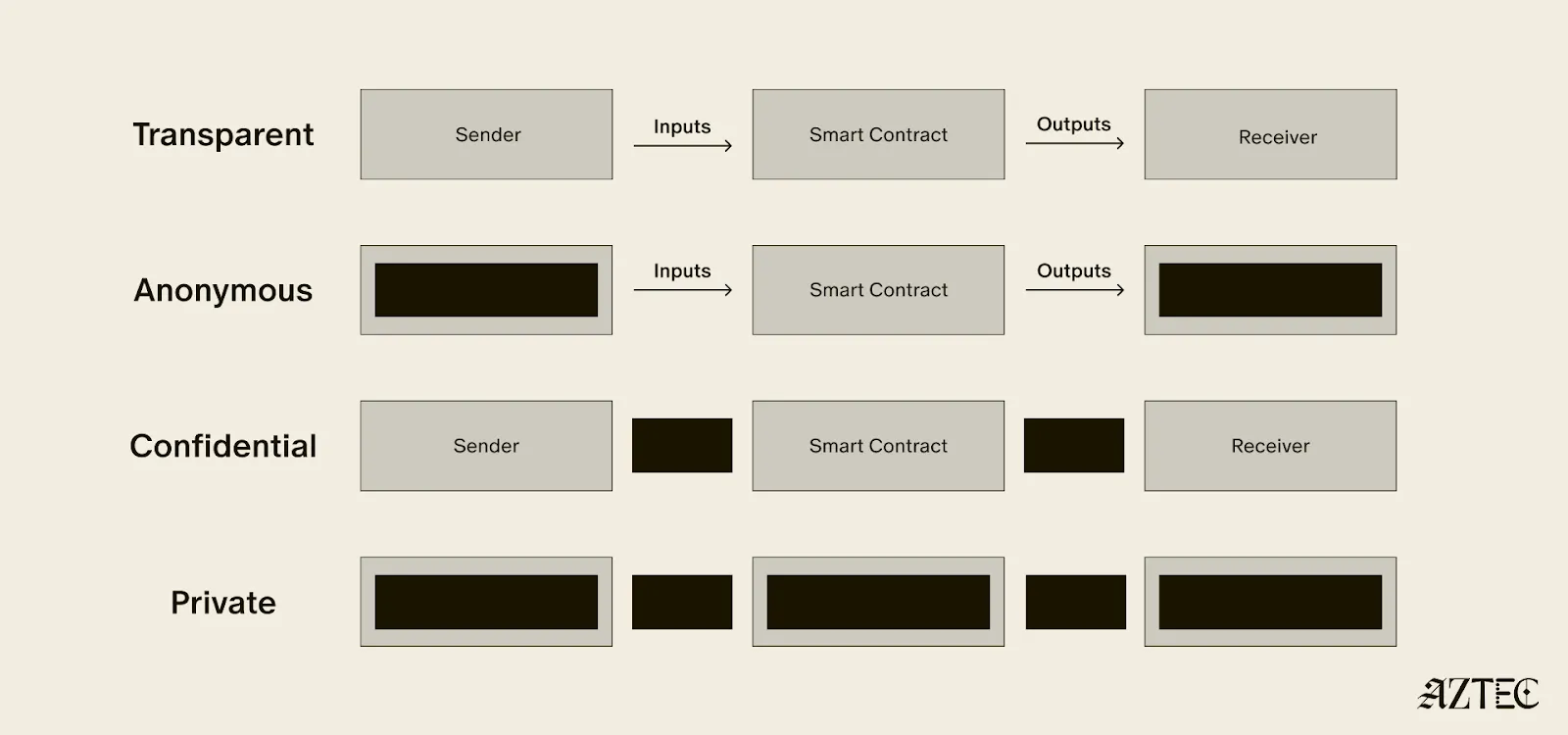
What exactly is a private world computer? A private world computer extends all the functionality of Ethereum with optional privacy at every level, so developers can easily control which aspects they want public or private and users can selectively disclose information. With Aztec, developers can build apps with optional transaction, identity, and compute privacy on a fully decentralized network. Below, we’ll break down the main components of a private world computer.
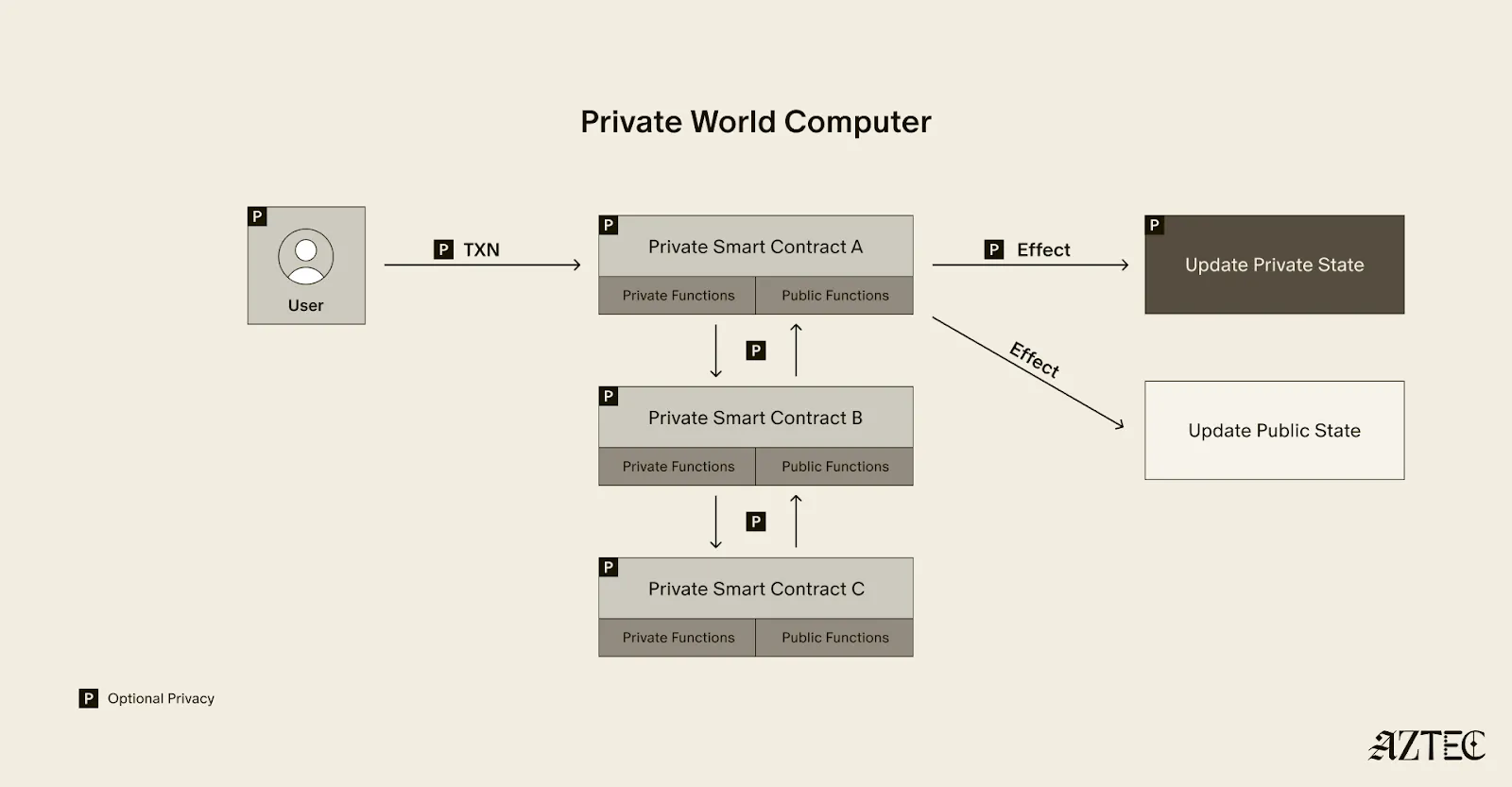
A private world computer is powered by private smart contracts. Private smart contracts have fully optional privacy and also enable seamless public and private function interaction.
Private smart contracts simply extend the functionality of regular smart contracts with added privacy.
As a developer, you can easily designate which functions you want to keep private and which you want to make public. For example, a voting app might allow users to privately cast votes and publicly display the result. Private smart contracts can also interact privately with other smart contracts, without needing to make it public which contracts have interacted.
Transaction: Aztec supports the optionality for fully private inputs, including messages, state, and function calldata. Private state is updated via a private UTXO state tree.
Identity: Using client-side proofs and function execution, Aztec can optionally keep all user info private, including tx.origin and msg.sender for transactions.
Computation: The contract code itself, function execution, and call stack can all be kept private. This includes which contracts you call, what functions in those contracts you’ve called, what the results of those functions were, and what the inputs to the function were.
A decentralized network must be made up of a permissionless network of operators who run the network and decide on upgrades. Aztec is run by a decentralized network of node operators who propose and attest to transactions. Rollup proofs on Aztec are also run by a decentralized prover network that can permissionlessly submit proofs and participate in block rewards. Finally, the Aztec network is governed by the sequencers, who propose, signal, vote, and execute network upgrades.
A private world computer enables the creation of DeFi applications where accounts, transactions, order books, and swaps remain private. Users can protect their trading strategies and positions from public view, preventing front-running and maintaining competitive advantages. Additionally, users can bridge privately into cross-chain DeFi applications, allowing them to participate in DeFi across multiple blockchains while keeping their identity private despite being on an existing transparent blockchain.
This technology makes it possible to bring institutional trading activity on-chain while maintaining the privacy that traditional finance requires. Institutions can privately trade with other institutions globally, without having to touch public markets, enjoying the benefits of blockchain technology such as fast settlement and reduced counterparty risk, without exposing their trading intentions or volumes to the broader market.
Organizations can bring client accounts and assets on-chain while maintaining full compliance. This infrastructure protects on-chain asset trading and settlement strategies, ensuring that sophisticated financial operations remain private. A private world computer also supports private stablecoin issuance and redemption, allowing financial institutions to manage digital currency operations without revealing sensitive business information.
Users have granular control over their privacy settings, allowing them to fine-tune privacy levels for their on-chain identity according to their specific needs. The system enables selective disclosure of on-chain activity, meaning users can choose to reveal certain transactions or holdings to regulators, auditors, or business partners while keeping other information private, meeting compliance requirements.
The shift from transparent blockchains to privacy-preserving infrastructure is the foundation for bringing the next billion users on-chain. Whether you're a developer building the future of private DeFi, an institution exploring compliant on-chain solutions, or simply someone who believes privacy is a fundamental right, now is the time to get involved.
Follow Aztec on X to stay updated on the latest developments in private smart contracts and decentralized privacy technology. Ready to contribute to the network? Run a node and help power the private world computer.
The next Renaissance is here, and it’s being powered by the private world computer.
After eight years of solving impossible problems, the next renaissance is here.
We’re at a major inflection point, with both our tech and our builder community going through growth spurts. The purpose of this rebrand is simple: to draw attention to our full-stack privacy-native network and to elevate the rich community of builders who are creating a thriving ecosystem around it.
For eight years, we’ve been obsessed with solving impossible challenges. We invented new cryptography (Plonk), created an intuitive programming language (Noir), and built the first decentralized network on Ethereum where privacy is native rather than an afterthought.
It wasn't easy. But now, we're finally bringing that powerful network to life. Testnet is live with thousands of active users and projects that were technically impossible before Aztec.
Our community evolution mirrors our technical progress. What started as an intentionally small, highly engaged group of cracked developers is now welcoming waves of developers eager to build applications that mainstream users actually want and need.
A brand is more than aesthetics—it's a mental model that makes Aztec's spirit tangible.
Renaissance means "rebirth"—and that's exactly what happens when developers gain access to privacy-first infrastructure. We're witnessing the emergence of entirely new application categories, business models, and user experiences.
The faces of this renaissance are the builders we serve: the entrepreneurs building privacy-preserving DeFi, the activists building identity systems that protect user privacy, the enterprise architects tokenizing real-world assets, and the game developers creating experiences with hidden information.
This next renaissance isn't just about technology—it's about the ethos behind the build. These aren't just our values. They're the shared DNA of every builder pushing the boundaries of what's possible on Aztec.
Agency: It’s what everyone deserves, and very few truly have: the ability to choose and take action for ourselves. On the Aztec Network, agency is native
Genius: That rare cocktail of existential thirst, extraordinary brilliance, and mind-bending creation. It’s fire that fuels our great leaps forward.
Integrity: It’s the respect and compassion we show each other. Our commitment to attacking the hardest problems first, and the excellence we demand of any solution.
Obsession: That highly concentrated insanity, extreme doggedness, and insatiable devotion that makes us tick. We believe in a different future—and we can make it happen, together.
Just as our technology bridges different eras of cryptographic innovation, our new visual identity draws from multiple periods of human creativity and technological advancement.
Our new wordmark embodies the diversity of our community and the permissionless nature of our network. Each letter was custom-drawn to reflect different pivotal moments in human communication and technological progress.
Together, these letters tell the story of human innovation: each era building on the last, each breakthrough enabling the next renaissance. And now, we're building the infrastructure for the one that's coming.
We evolved our original icon to reflect this new chapter while honoring our foundation. The layered diamond structure tells the story:
The architecture echoes a central plaza—the Roman forum, the Greek agora, the English commons, the American town square—places where people gather, exchange ideas, build relationships, and shape culture. It's a fitting symbol for the infrastructure enabling the next leap in human coordination and creativity.
From the Mughal and Edo periods to the Flemish and Italian Renaissance, our brand imagery draws from different cultures and eras of extraordinary human flourishing—periods when science, commerce, culture and technology converged to create unprecedented leaps forward. These visuals reflect both the universal nature of the Renaissance and the global reach of our network.
But we're not just celebrating the past —we're creating the future: the infrastructure for humanity's next great creative and technological awakening, powered by privacy-native blockchain technology.
Join us to ask questions, learn more and dive into the lore.
Join Our Discord Town Hall. September 4th at 8 AM PT, then every Thursday at 7 AM PT. Come hear directly from our team, ask questions, and connect with other builders who are shaping the future of privacy-first applications.
Take your stance on privacy. Visit the privacy glyph generator to create your custom profile pic and build this new world with us.
Stay Connected. Visit the new website and to stay up-to-date on all things Noir and Aztec, make sure you’re following along on X.
The next renaissance is what you build on Aztec—and we can't wait to see what you'll create.
Aztec’s Public Testnet launched in May 2025.
Since then, we’ve been obsessively working toward our ultimate goal: launching the first fully decentralized privacy-preserving layer-2 (L2) network on Ethereum. This effort has involved a team of over 70 people, including world-renowned cryptographers and builders, with extensive collaboration from the Aztec community.
To make something private is one thing, but to also make it decentralized is another. Privacy is only half of the story. Every component of the Aztec Network will be decentralized from day one because decentralization is the foundation that allows privacy to be enforced by code, not by trust. This includes sequencers, which order and validate transactions, provers, which create privacy-preserving cryptographic proofs, and settlement on Ethereum, which finalizes transactions on the secure Ethereum mainnet to ensure trust and immutability.
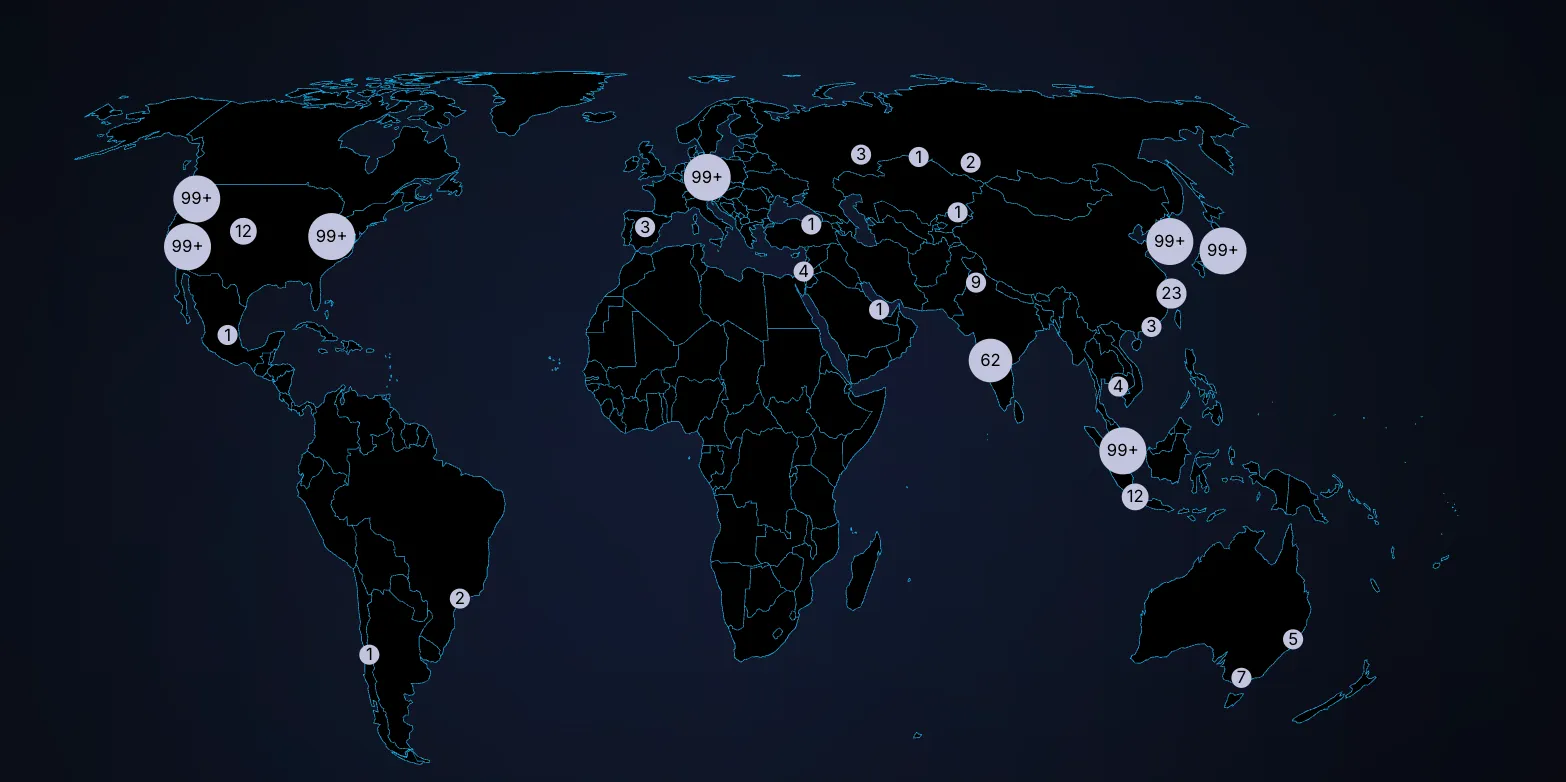
Strong progress is being made by the community toward full decentralization. The Aztec Network now includes nearly 1,000 sequencers in its validator set, with 15,000 nodes spread across more than 50 countries on six continents. With this globally distributed network in place, the Aztec Network is ready for users to stress test and challenge its resilience.
We're now entering a new phase: the Adversarial Testnet. This stage will test the resilience of the Aztec Testnet and its decentralization mechanisms.
The Adversarial Testnet introduces two key features: slashing, which penalizes validators for malicious or negligent behavior in Proof-of-Stake (PoS) networks, and a fully decentralized governance mechanism for protocol upgrades.
This phase will also simulate network attacks to test its ability to recover independently, ensuring it could continue to operate even if the core team and servers disappeared (see more on Vitalik’s “walkaway test” here). It also opens the validator set to more people using ZKPassport, a private identity verification app, to verify their identity online.
The Aztec Network testnet is decentralized, run by a permissionless network of sequencers.
The slashing upgrade tests one of the most fundamental mechanisms for removing inactive or malicious sequencers from the validator set, an essential step toward strengthening decentralization.
Similar to Ethereum, on the Aztec Network, any inactive or malicious sequencers will be slashed and removed from the validator set. Sequencers will be able to slash any validator that makes no attestations for an entire epoch or proposes an invalid block.
Three slashes will result in being removed from the validator set. Sequencers may rejoin the validator set at any time after getting slashed; they just need to rejoin the queue.
In addition to testing network resilience when validators go offline and evaluating the slashing mechanisms, the Adversarial Testnet will also assess the robustness of the network’s decentralized governance during protocol upgrades.
Adversarial Testnet introduces changes to Aztec Network’s governance system.
Sequencers now have an even more central role, as they are the sole actors permitted to deposit assets into the Governance contract.
After the upgrade is defined and the proposed contracts are deployed, sequencers will vote on and implement the upgrade independently, without any involvement from Aztec Labs and/or the Aztec Foundation.
Starting today, you can join the Adversarial Testnet to help battle-test Aztec’s decentralization and security. Anyone can compete in six categories for a chance to win exclusive Aztec swag, be featured on the Aztec X account, and earn a DappNode. The six challenge categories include:
Performance will be tracked using Dashtec, a community-built dashboard that pulls data from publicly available sources. Dashtec displays a weighted score of your validator performance, which may be used to evaluate challenges and award prizes.
The dashboard offers detailed insights into sequencer performance through a stunning UI, allowing users to see exactly who is in the current validator set and providing a block-by-block view of every action taken by sequencers.
To join the validator set and start tracking your performance, click here. Join us on Thursday, July 31, 2025, at 4 pm CET on Discord for a Town Hall to hear more about the challenges and prizes. Who knows, we might even drop some alpha.
To stay up-to-date on all things Noir and Aztec, make sure you’re following along on X.
On May 1st, 2025, Aztec Public Testnet went live.
Within the first 24 hours, over 20k users visited the Aztec Playground and started to send transactions on testnet. Additionally, 10 apps launched live on the testnet, including wallets, block explorers, and private DeFi and NFT marketplaces. Launching a decentralized testnet poses significant challenges, and we’re proud that the network has continued to run despite high levels of congestion that led to slow block production for a period of time.
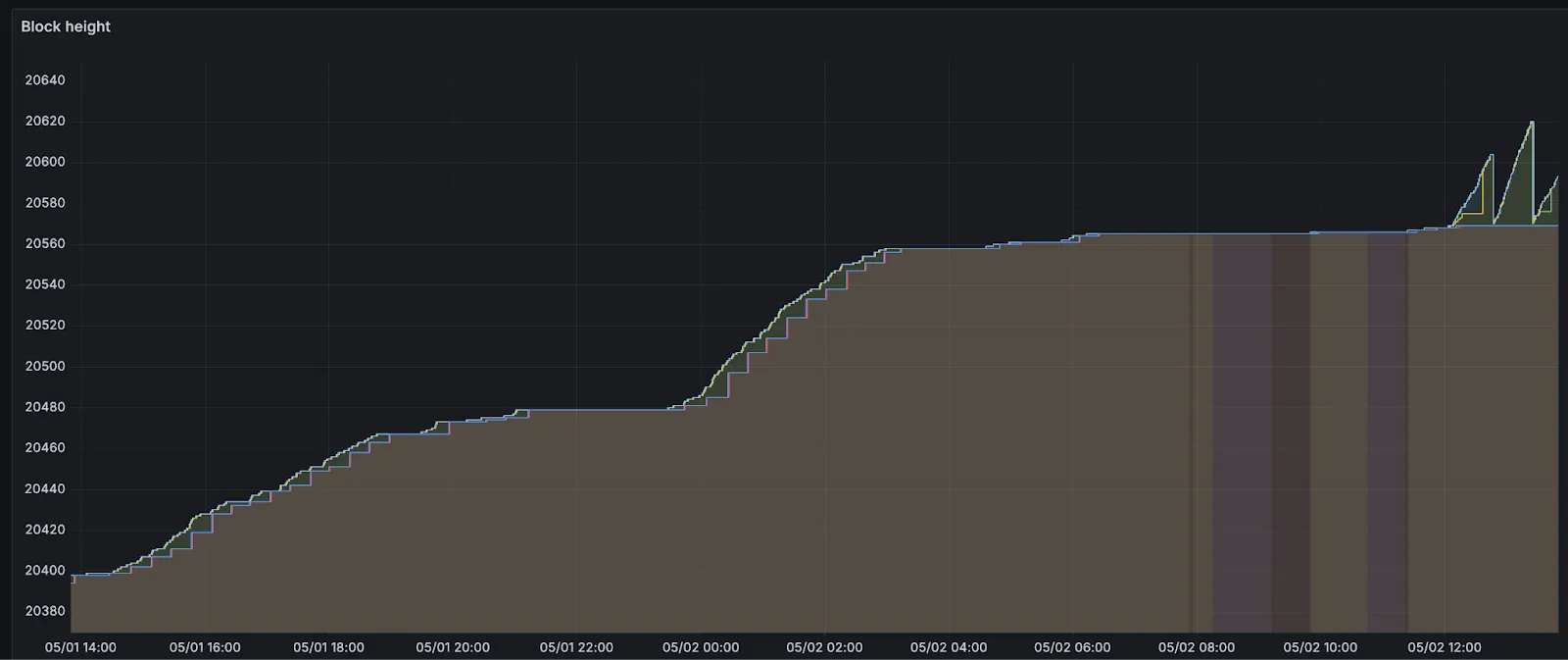
Around 6 hours after announcing the network launch, more than 150 sequencers had joined the validator set to sequence transactions and propose blocks for the network. 500+ additional full nodes were spun up by node operators participating in our Discord community. These sequencers were flooded with over 5k transactions before block production slowed. Let’s dive into why block production slowed down.
On Aztec, an epoch is a group of 32 blocks that are rolled up for settlement on Ethereum. Leading up to the slowdown of block production, there were entire epochs with full blocks (8 transactions, or 0.2TPS) in every slot. The sequencers were building blocks and absorbing the demand for blockspace from users of the Aztec playground, and there was a build up of 100s of pending transactions in sequencer mempools.
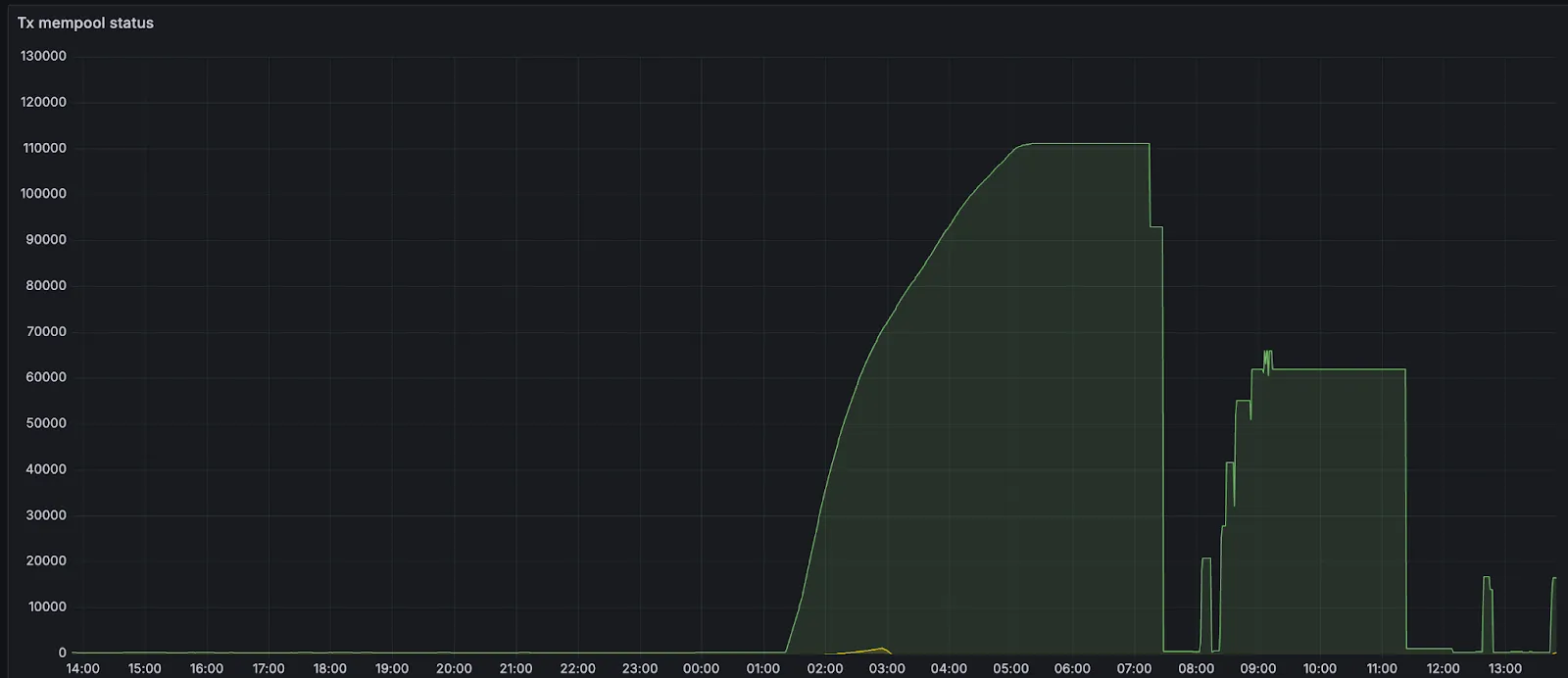
Issues arose when these transactions started to exceed the mempool size, which was configured to hold only 100mb or about 700 transactions.
As many new validators were brought through the funnel and started to come online, the mempools of existing validators (already full at 700 transactions) and new ones (at 0 transactions) diverged significantly. When earlier validators proposed blocks, newer validators didn't have the transactions and could not attest to blocks because the request/response protocol wasn't aggressive enough. When newer validators made proposals, earlier validators didn't have transactions (their mempools were full), so they could not attest to blocks.
New validators then started to build up pending transactions. When validators with full mempools requested missing transactions from peers, they would evict existing transactions from their mempools (mempool is at max memory) based on priority fee. All transactions had default fee settings, so validators were randomly ejecting transactions and were not doing so in lockstep (different validators ejected different transactions). For a little over an hour, the mempools diverged significantly from each other, and block production slowed down to about 20% of the expected rate.
In order to stop the mempool from ejecting transactions, the p2p mempool size was increased. By increasing the mempool size, the likelihood of needing to evict transactions that might soon appear in proposals is reduced. This increases the chances that sequencers already have the necessary transactions locally when they receive a block proposal. As a result, more validators are able to attest to proposals, allowing blocks to be finalized more reliably. Once blocks are included on L1, their transactions are evicted from the mempool. So over time, as more blocks are finalized and transactions are mined, the mempool naturally shrinks and the network will recover on its own.
If you are interested in running a sequencer node visit the sequencer page. Stay up-to-date on Noir and Aztec by following Noir and Aztec on X.
Preventing sybil attacks and malicious actors is one of the fundamental challenges of Web3 – it’s why we have proof-of-work and proof-of-stake networks. But Sybil attacks go a step further for many projects, with bots and advanced AI agents flooding Discord servers, sending thousands of transactions that clog networks, and botting your Typeforms. Determining who is a real human online and on-chain is becoming increasingly difficult, and the consequences of this are making it difficult for projects to interact with real users.
When the Aztec Testnet launched last month, we wrote about the challenges of running a proof-of-stake testnet in an environment where bots are everywhere. The Aztec Testnet is a decentralized network, and in order to give good actors a chance, a daily quota was implemented to limit the number of new sequencers that could join the validator set per day to start proposing blocks. Using this system, good actors who were already in the set could vote to kick out bad actors, with a daily limit of 5 new sequencers able to join the set each day. However, the daily quota quickly got bottlenecked, and it became nearly impossible for real humans who are operating nodes in good faith to join the Aztec Testnet.
In this case study, we break down Sybil attacks, explore different ways the ecosystem currently uses to prevent them, and dive into how we’re leveraging ZKPassport to prevent Sybil attacks on the Aztec Testnet.
With the massive repercussions that stem from privacy leaks (see the recent Coinbase incident), any solution to prevent Sybil attacks and prove humanity must not compromise on user privacy and should be grounded in the principles of privacy by design and data minimization. Additionally, given that decentralization underpins the entire purpose of Web3 (and the Aztec Network), joining the network should remain permissionless.
Our goal was to find a solution that allows users to permissionlessly prove their humanity without compromising their privacy. If such a technology exists (spoiler alert: it does), we believe that this has the potential to solve one of the biggest problems faced by our industry: Sybil attacks. Some of the ways that projects currently try to prevent Sybil attacks or prove [humanity] include:
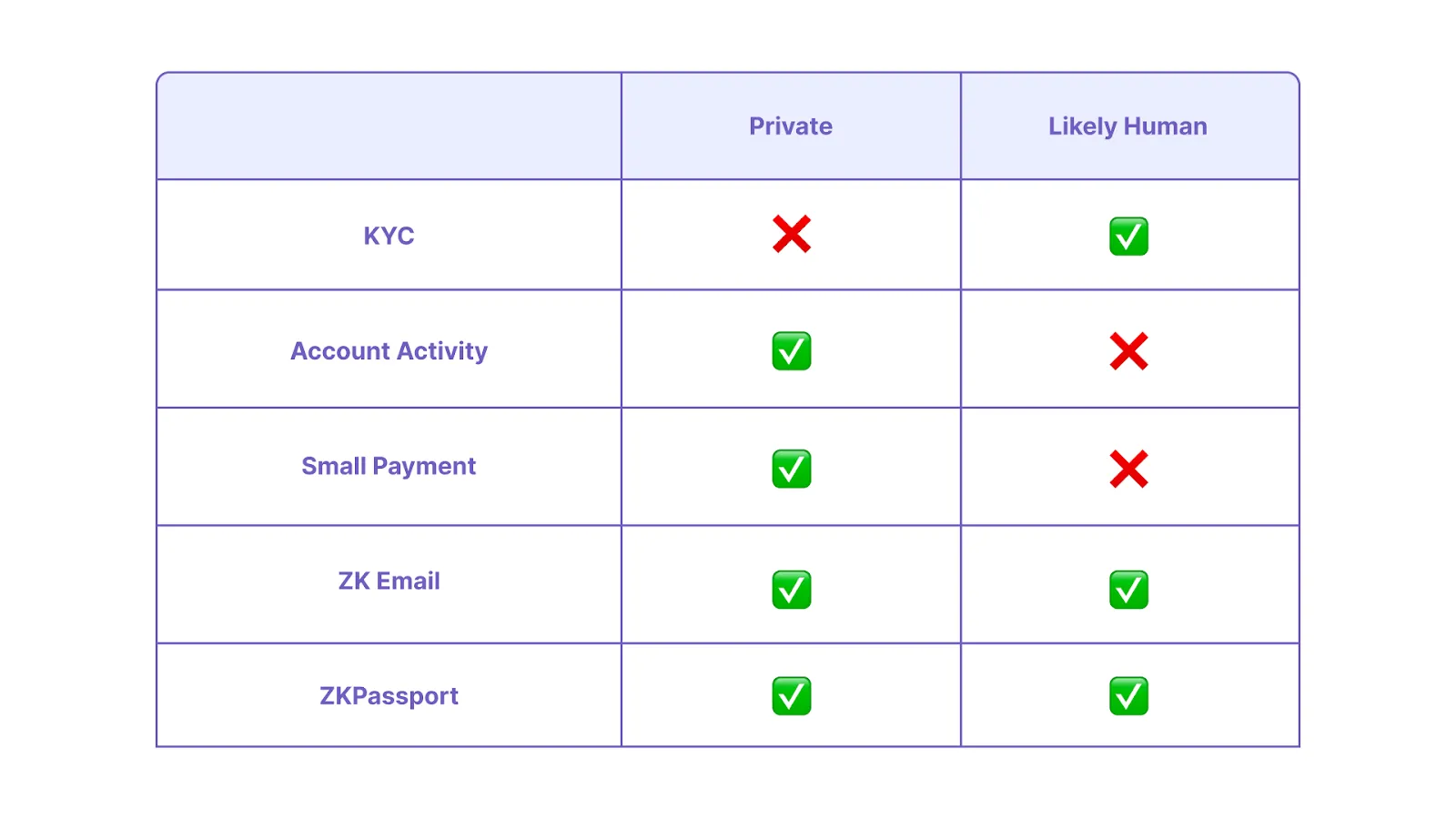
Both zkEmail and ZKPassport are powered by Noir, the universal language of zk, and are great solutions for preventing Sybil attacks.
With zkEmail, users can do things like prove that they received a confirmation email from a centralized exchange showing that they successfully passed KYC, all without showing any of the email contents or personal information. While this offers a good solution for this use case, we also wanted the functionality of enabling the network to block certain jurisdictions (if needed), without the network knowing where the user is from. This also enables users to directly interface with the network rather than through a third-party email confirmation.
Given this context, ZKPassport was, and is, the perfect fit.
For the Aztec Testnet, we’ve integrated ZKPassport to enable node operators to prove they are human and participate in the network. This integration allows the network to dramatically increase the number of sequencers that can be added each day, which is a huge step forward in decentralizing the network with real operators.
ZKPassport allows users to share only the details about themselves that they choose by scanning a passport or government ID. This is achieved using zero-knowledge proofs (ZKPs) that are generated locally on the user’s phone. Implementing client-side zk-proofs in this way enables novel use-cases like age verification, where someone can prove their age without actually sharing how old they are (see the recent report on How to Enable Age Verification on the Internet Today Using Zero-Knowledge Proofs).
As of this week, the ZKPassport app is live and available to download on Google Play and the Apple App Store.
Most countries today issue biometric passports or national IDs containing NFC chips (over 120 countries are currently supported by ZKPassport). These chips contain information on the full name, date of birth, nationality, and even digital photographs of the passport or ID holder. They can also contain biometric data such as fingerprints and iris scans.
By scanning the NFC chip located in their ID document with a smartphone, users generate proof based on a specific request from an app. For example, some apps might require only the user’s age or nationality. In the case of Aztec, no information is needed about the user other than that they do indeed hold a valid passport or ID.
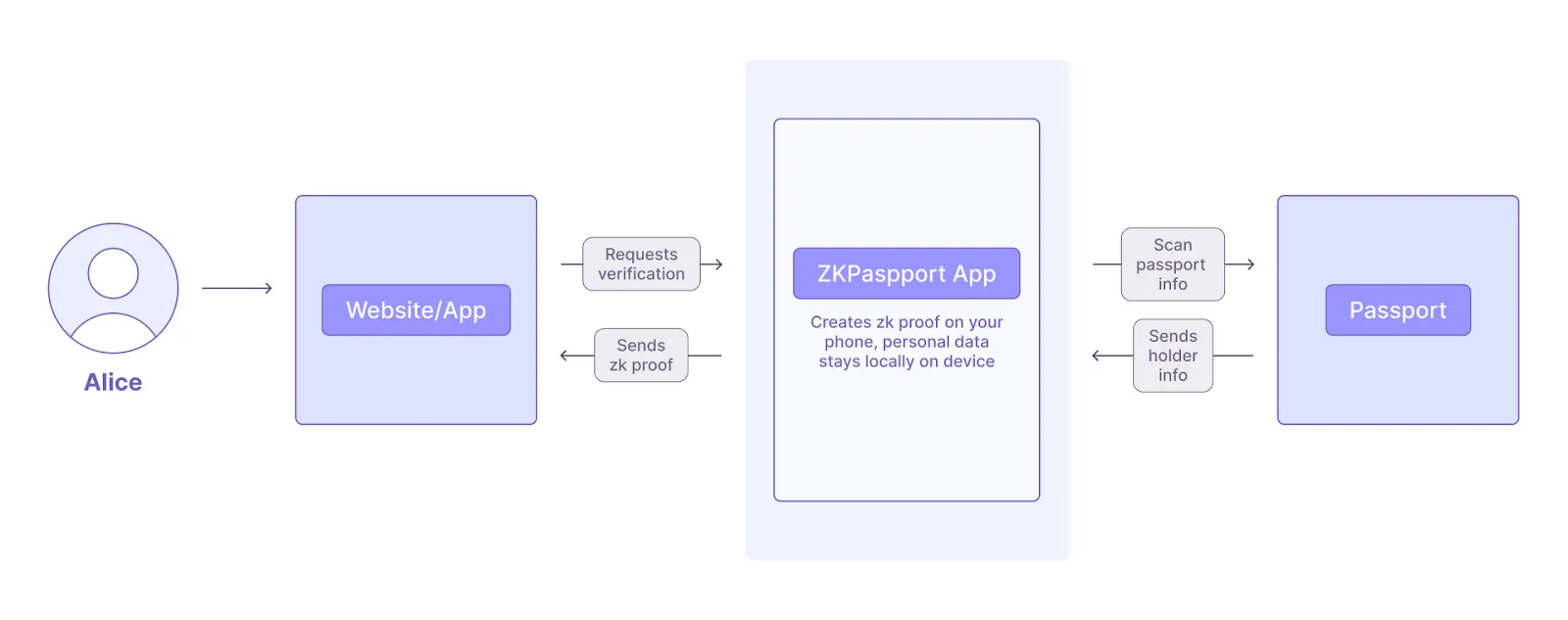
Once the user installs the ZKPassport app and scans their passport, the proof of identity is generated on the user's smartphone (client-side).
All the private data read from the NFC chip in the passport or ID is processed client-side and never leaves the smartphone (aka: only the user is aware of their data). Only this proof is sent to an app that has requested some information. The app can then verify the validity of the user’s age or nationality, all without actually seeing anything about the user other than what the user has authorized the app to see. In the case of age verification, the user may want to prove that they are over 18, so they’ll create a proof of this on their phone, and the requesting app is able to verify this information without knowing anything else about them.
For the Aztec Testnet, the network only needs to know that the user holds a valid passport, so no information is shared by the user other than “yes, I hold a valid passport or ID.”
This is a nascent and evolving technology, and various phone models, operating systems, and countries are still being optimized for. To ensure this works seamlessly, we’ll be selecting the first cohort of people who have already been running active validators on a rolling basis to help test ZKPassport and provide early feedback.
If someone successfully verifies that they are a valid passport holder, they will be added to a queue to enter the validator set. Once they are in line, they are guaranteed entry. The queue will enable an estimated additional 10% of the current set to be allowed in each day. For example, if 800 sequencers are currently in the set, 80 new sequencers will be allowed to join that day.
This allows existing operators to maintain control of the network in the event that bad actors enter, while dramatically increasing the number of new validators added compared to the current number.
With ZKPassport now live, the Aztec Testnet is better equipped to distinguish real users from bots, without compromising on privacy or decentralization.
This integration is already enabling more verified human node operators to join the validator set, and the network is ready to welcome more. By leveraging ZKPs and client-side proving, ZKPassport ensures that humanity checks are both secure and permissionless, bringing us closer to a decentralized future that doesn’t rely on trust in centralized authorities.
This is exciting not just for Aztec but for the broader ecosystem. As the network continues to grow and develop, participation must remain open to anyone acting in good faith, regardless of geography or background, while keeping out bots and other malicious actors. ZKPassport makes this possible.
We’re excited to see the community expand, powered by real people helping to build a more private, inclusive, and human Web3.
Stay up-to-date on Noir and Aztec by following Noir and Aztec on X.
Imagine an app that allows users to post private messages while proving they belong to an organization, without revealing their identity. Thanks to zero-knowledge proofs (ZKPs), it's now possible to protect the user’s identity through secure messaging, confidential voting, secured polling, and more. This development in privacy-preserving authentication creates powerful new ways for teams and individuals to communicate on the Internet while keeping aspects of their identity private.
Compared to Glassdoor, StealthNote is an app that allows users to post messages privately while proving they belong to a specific organization. Built with Noir, an open-source programming language for writing ZK programs, StealthNote utilizes ZKPs to prove ownership of a company email address, without revealing the particular email or other personal information.
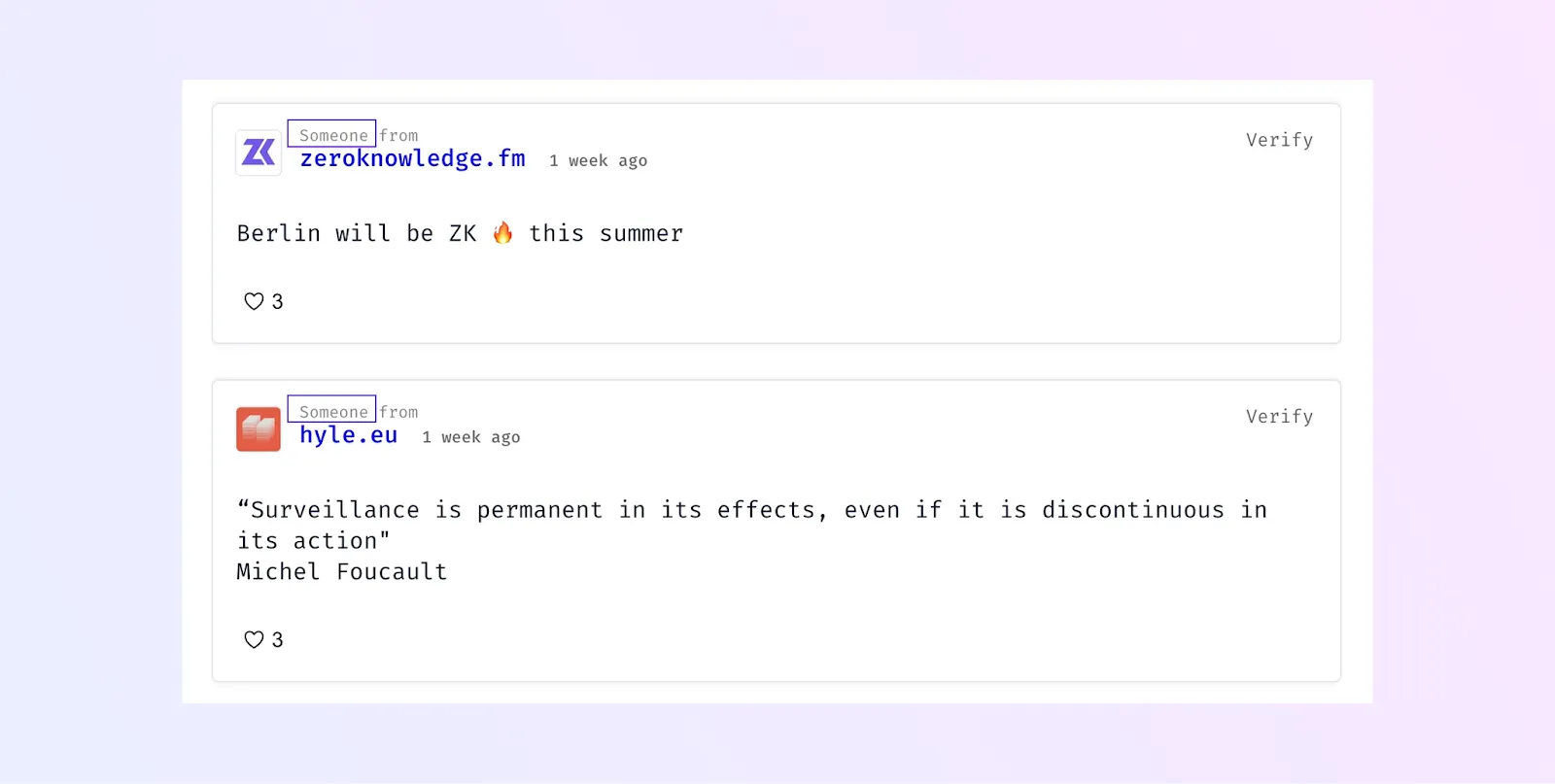
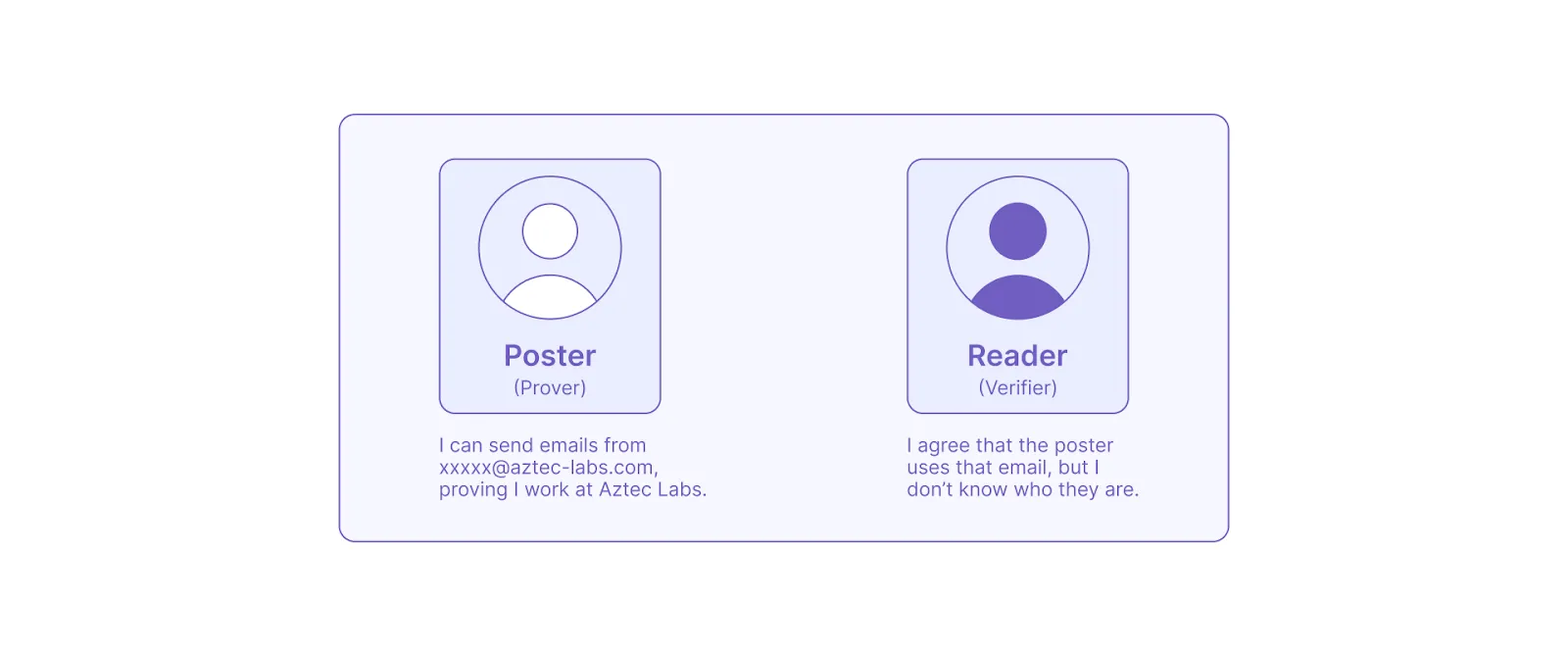
To prove the particular domain email ownership, the app asks users to sign in using Google. This utilizes Google’s ‘Sign in with Google’ OAuth authorization. OAuth is usually used by external applications for user authorization and returns verified users’ data, such as name, email, and the organization’s domain.
However, using ‘Sign in with Google’ in a traditional way reveals all of the information about the person’s identity to the app. Furthermore, for an app where you want to allow the public to verify the information about a user, all of this information would be made public to the world. That’s where StealthNote steps in, enabling part of the returned user data to stay private (e.g. name and email) and part of it to be publicly verifiable (e.g. company domain).
When you "Sign in with Google" in a third-party app, Google returns some information about the user as a JSON Web Token (JWT) – a standard for sending information around the web.
JWTs are just formatted strings that contain a header (some info about the token), a payload (data about the user), and a signature to ensure the integrity and authenticity of the token:
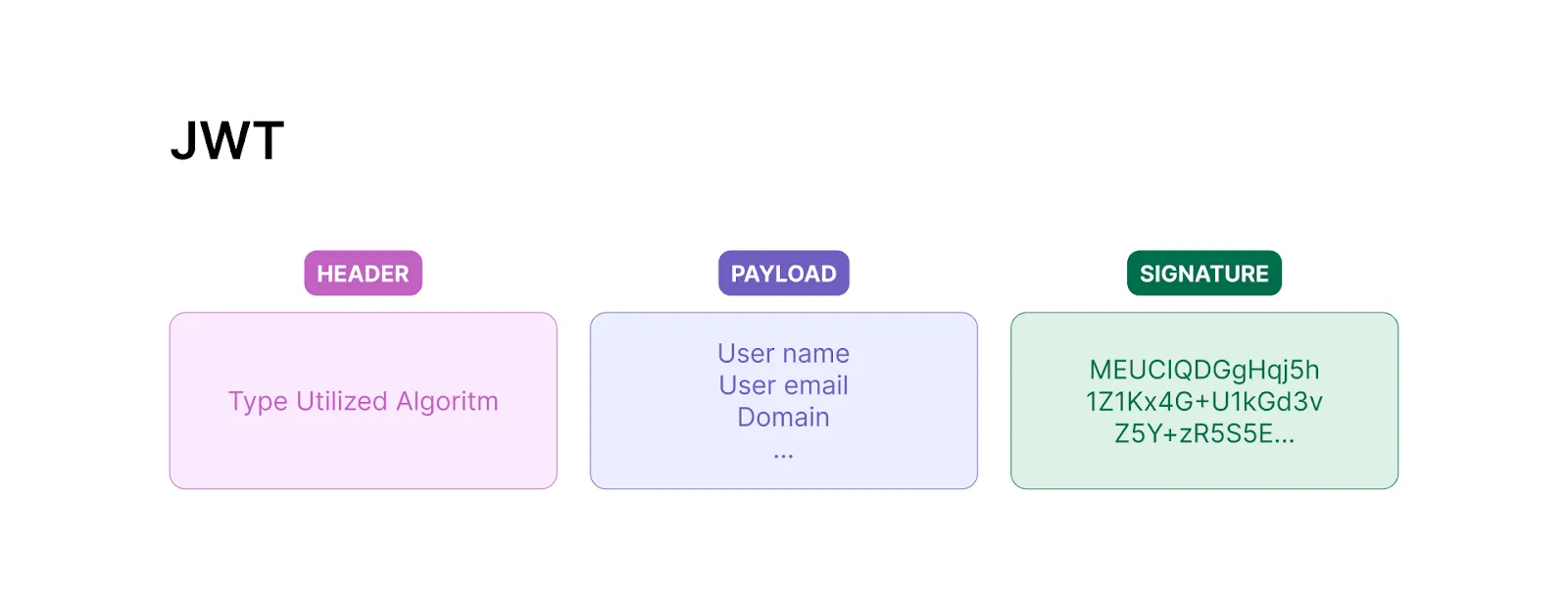
Anyone can verify the authenticity of the above data by verifying that the JWT was signed by Google using their public key.
In the case of StealthNote, we want to authorize the user and prove that they sent a particular message. To make this possible, custom information is added to the JWT token payload – a hashed message. With this additional field, the JWT becomes a digitally signed proof that a particular user sent that exact message.
You can share the message and the JWT with someone and convince them that the message was sent by someone in the company. However, this would require sharing the whole JWT, which includes your name and email, exposing who the sender is. So, how does StealthNote protect this information?
They used a ZK-programming language, Noir, with the following goals in mind:
The payload and the signature are kept private, meaning they stay on the user’s device and never need to be revealed, while the hashed message, the domain, and the JWT public key are public. The ZKP is generated in the browser, and no private data ever leaves the user's device.

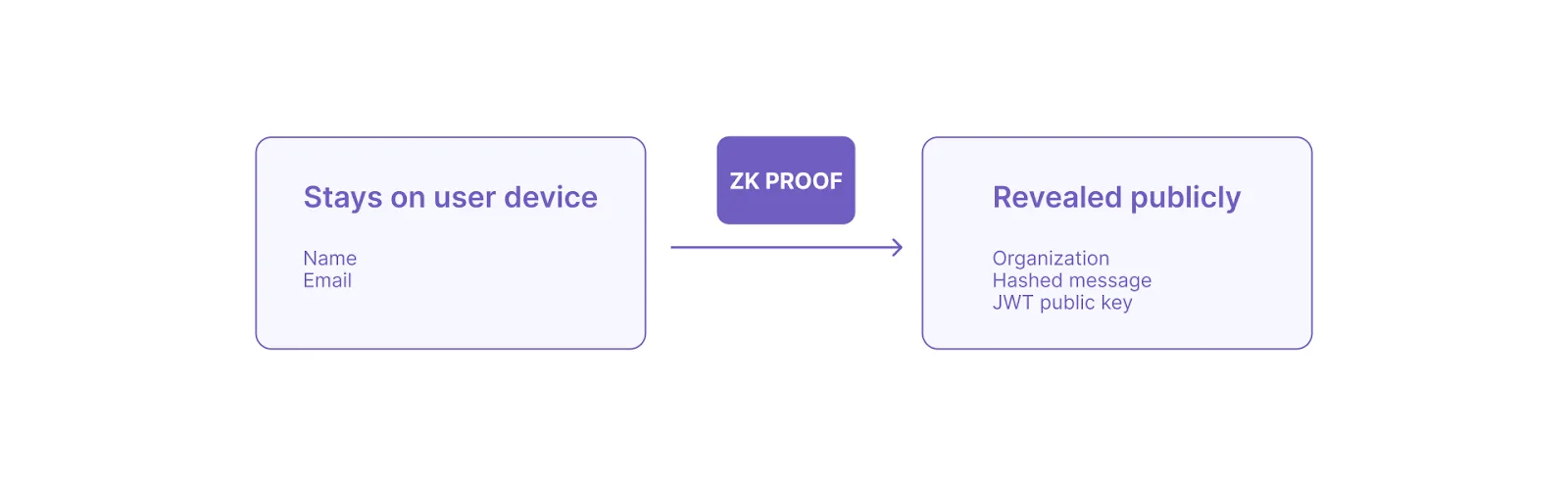
By executing the program with Noir and generating a proof, the prover (the user who is posting a message) proves that they can generate a JWT signed by some particular public key, and it contains an email field in the payload with the given domain.
When the message is sent to the StealthNote server, the server verifies that the proof is valid as per the StealthNote circuit and validates that the public key in the proof is the same as Google's public key.
Once both checks pass, the server inserts the proof into the database, which then appears in the feed visible for other users. Other users can also verify the proof in the browser. The role of the server is to act as a data storage layer.
Stay up-to-date on Noir and Aztec by following Noir and Aztec on X.
The global political discourse around protecting underage internet users is heating up as lawmakers struggle to achieve safe and secure internet access for minors without imposing on civil liberties.
The European Parliament’s global estimates reveal that one in three children is an internet user, and one in three internet users is under 18. As digital consumption by minors grows, policymakers worldwide are pushing for more stringent age verification laws. However, these efforts are increasingly met with legal and constitutional challenges.
This report explores the potential behind zero-knowledge proof (“ZKP”) identities (“ZKIs”) as an innovative solution for online age verification, offering the dual advantage of enabling robust identity verification while safeguarding personal information.
Click here to read the full report.
On May 1st, 2025, Aztec Public Testnet went live.
Within the first 24 hours, over 20k users visited the Aztec Playground and started to send transactions on testnet. Additionally, 10 apps launched live on the testnet, including wallets, block explorers, and private DeFi and NFT marketplaces. Launching a decentralized testnet poses significant challenges, and we’re proud that the network has continued to run despite high levels of congestion that led to slow block production for a period of time.
Around 6 hours after announcing the network launch, more than 150 sequencers had joined the validator set to sequence transactions and propose blocks for the network. 500+ additional full nodes were spun up by node operators participating in our Discord community. These sequencers were flooded with over 5k transactions before block production slowed. Let’s dive into why block production slowed down.
On Aztec, an epoch is a group of 32 blocks that are rolled up for settlement on Ethereum. Leading up to the slowdown of block production, there were entire epochs with full blocks (8 transactions, or 0.2TPS) in every slot. The sequencers were building blocks and absorbing the demand for blockspace from users of the Aztec playground, and there was a build up of 100s of pending transactions in sequencer mempools.
Issues arose when these transactions started to exceed the mempool size, which was configured to hold only 100mb or about 700 transactions.
As many new validators were brought through the funnel and started to come online, the mempools of existing validators (already full at 700 transactions) and new ones (at 0 transactions) diverged significantly. When earlier validators proposed blocks, newer validators didn't have the transactions and could not attest to blocks because the request/response protocol wasn't aggressive enough. When newer validators made proposals, earlier validators didn't have transactions (their mempools were full), so they could not attest to blocks.
New validators then started to build up pending transactions. When validators with full mempools requested missing transactions from peers, they would evict existing transactions from their mempools (mempool is at max memory) based on priority fee. All transactions had default fee settings, so validators were randomly ejecting transactions and were not doing so in lockstep (different validators ejected different transactions). For a little over an hour, the mempools diverged significantly from each other, and block production slowed down to about 20% of the expected rate.
In order to stop the mempool from ejecting transactions, the p2p mempool size was increased. By increasing the mempool size, the likelihood of needing to evict transactions that might soon appear in proposals is reduced. This increases the chances that sequencers already have the necessary transactions locally when they receive a block proposal. As a result, more validators are able to attest to proposals, allowing blocks to be finalized more reliably. Once blocks are included on L1, their transactions are evicted from the mempool. So over time, as more blocks are finalized and transactions are mined, the mempool naturally shrinks and the network will recover on its own.
If you are interested in running a sequencer node visit the sequencer page. Stay up-to-date on Noir and Aztec by following Noir and Aztec on X.